
























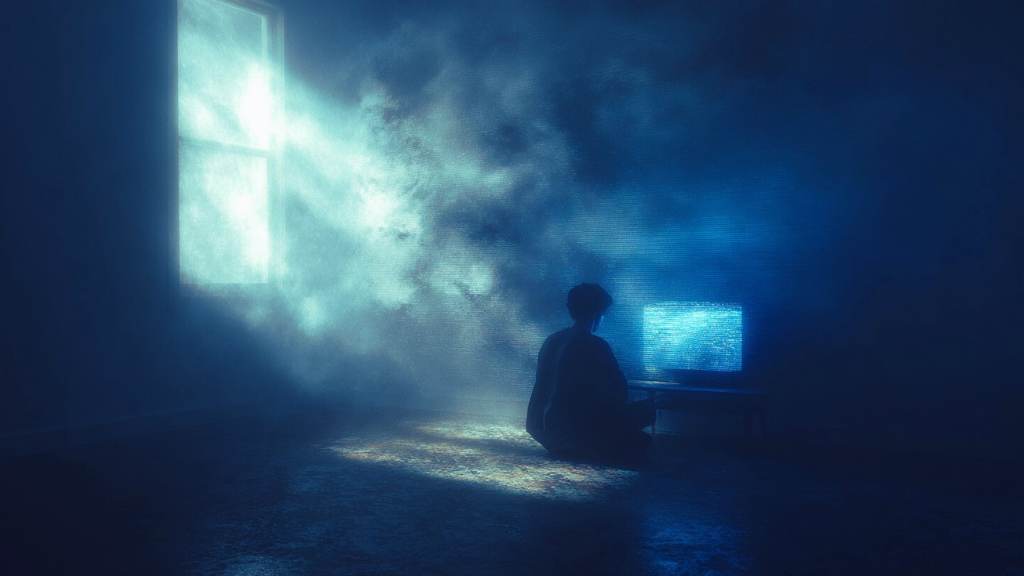
How to Calm a Racing Mind Without Silence
There is a specific kind of night.
The lights are off.
The room is quiet.
Your body is tired.
But your mind is louder than ever.
You replay conversations.
You imagine worst-case futures.
You analyze decisions that are already over.
Silence, instead of helping, makes it worse.
If this sounds familiar, you are not broken.
You are overstimulated.
And paradoxically, total silence is not always the solution.
This is where dark ambient music becomes powerful.
Not cheerful music.
Not guided meditation.
Not affirmations.
But slow, atmospheric sound designed to hold your thoughts without amplifying them.
Let’s break down why this works, and how to use it properly.
Why Silence Can Make Overthinking Worse
When the environment goes quiet, your brain searches for input.
If it doesn’t find external stimulation, it turns inward.
This activates:
- Rumination loops
- Anxiety pattern replay
- Intrusive thought cycles
- Hyper-awareness of bodily sensations
Your nervous system doesn’t automatically calm down just because it’s quiet.
It needs structured softness.
Dark ambient music provides exactly that.

What Makes Dark Ambient Different From “Relaxing Music”
Many relaxation playlists use:
- Bright piano
- Nature sounds
- Soft vocals
- Repetitive meditation tones
Those work for some people.
But for night overthinkers, bright sounds can feel artificial.
Dark ambient music works differently:
- Low-frequency textures
- Slow harmonic shifts
- Minimal melody
- No lyrical distraction
- Subtle emotional weight
Instead of trying to force positivity, it creates containment.
It gives your thoughts a space to exist, without escalating them.
The Psychology Behind It
Dark ambient sound helps in three key ways:
1. Auditory Anchoring
Your brain focuses gently on evolving sound textures.
This reduces cognitive bandwidth available for rumination.
You’re not suppressing thoughts.
You’re reducing their dominance.
2. Emotional Validation
Unlike upbeat music, dark ambient acknowledges depth.
If you feel heavy, uncertain, or reflective – the music doesn’t contradict you.
It mirrors you calmly.
This reduces internal resistance.
3. Nervous System Regulation
Low, sustained tones can:
- Slow breathing rhythm
- Lower heart rate variability spikes
- Reduce hypervigilance
Especially when played at low volume.
It acts like a dim light for your nervous system.
How to Use Dark Ambient Music at Night (Properly)
Most people use it wrong.
They:
- Play it too loud
- Shuffle between tracks
- Combine it with screen scrolling
Here’s the correct method.
Step 1: Lower the Volume More Than You Think
It should feel like it’s in the walls, not in your ears.
Step 2: Choose Long, Minimal Tracks
Avoid sudden transitions.
Long-form atmospheric tracks work best or the correct playlists.
Step 3: Pair It With Dim Lighting
No blue light.
No phone scrolling.
Let the sound become environmental.
Step 4: Don’t Try to “Stop Thinking”
Let thoughts pass through the sound.
The goal is not silence.
It’s softening.

Why Dark Lofi Works Especially Well
Dark lofi combines:
- Subtle rhythmic grounding
- Warm analog textures
- Slight nostalgic tone
- Repetition without sharp edges
It gives your mind something to lean on, without pulling it forward.
For people who overthink at night, rhythm can feel safer than total ambient abstraction.
It adds a gentle structure.
When This Is Most Effective
Dark ambient music is especially helpful for:
- Nighttime rumination
- Post-social exhaustion
- Creative burnout
- Late-night writing sessions
- Emotional processing
- Transitional life phases
It is not a cure.
But it is a stabilizer.
A Simple 15-Minute Night Reset
If your mind won’t shut off tonight, try this:
- Turn off overhead lights
- Put on low-volume dark ambient music
- Sit or lie down comfortably
- Inhale slowly for 4 seconds
- Exhale for 6 seconds
- Repeat for 5 minutes
- Then allow the music to continue without effort
Do not force sleep.
Let the music create mental distance.
Often, sleep follows naturally.
Final Thought
Overthinking at night is not weakness.
It is a nervous system that hasn’t fully powered down.
Silence can expose it.
Dark ambient music can hold it.
You don’t need to silence your mind.
You need to lower the volume of its intensity.
And sometimes, the right atmosphere is enough.



















Comments 1