








Intro
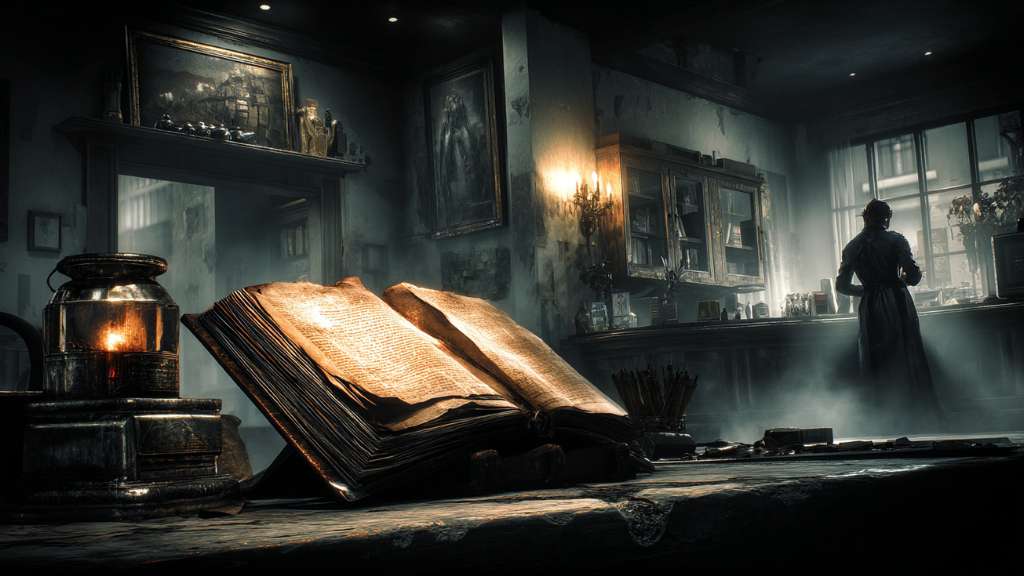
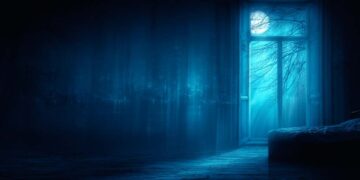
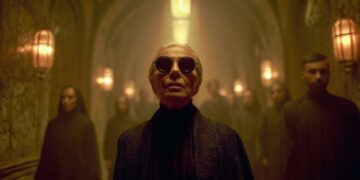
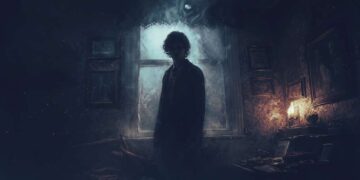
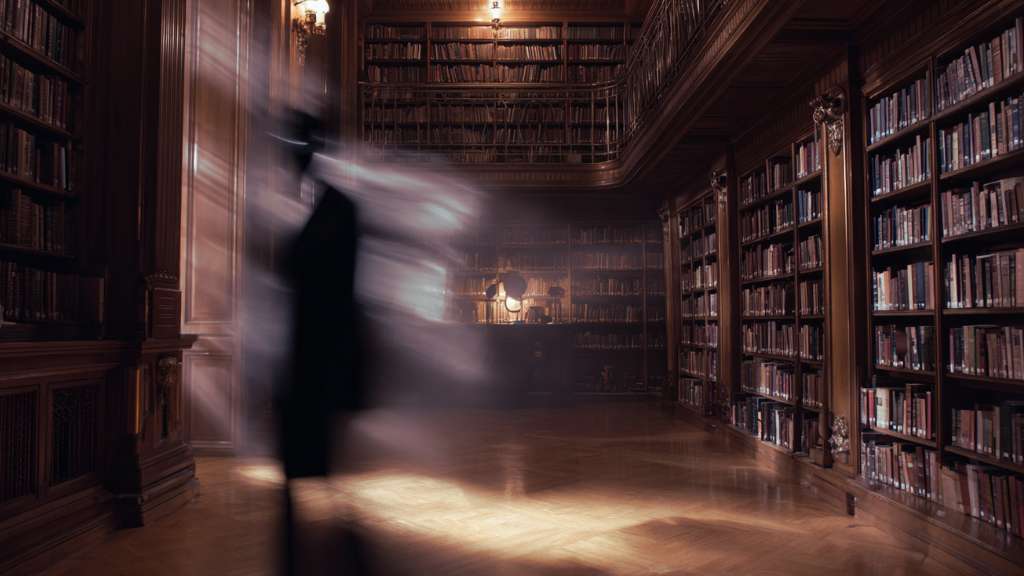
Some places remember more than they reveal. Libraries, especially, are not neutral spaces; they absorb intention, hesitation, and the quiet residue of people who came searching for something they could not name. This image captures a moment inside such a place: a figure blurred by motion, light cutting through dust and wood, knowledge standing still while something unresolved passes through it. Ashborn belongs to this threshold, where identity has already been burned once and continues to move forward anyway.

Best listened with:
- Headphones or a low-volume speaker system
- Warm, dim lighting or late-afternoon natural light
- A quiet interior space
- A mentally heavy or reflective state
- Ideal for reading, slow writing, or inward focus
- Listen to dark ambient music while reading
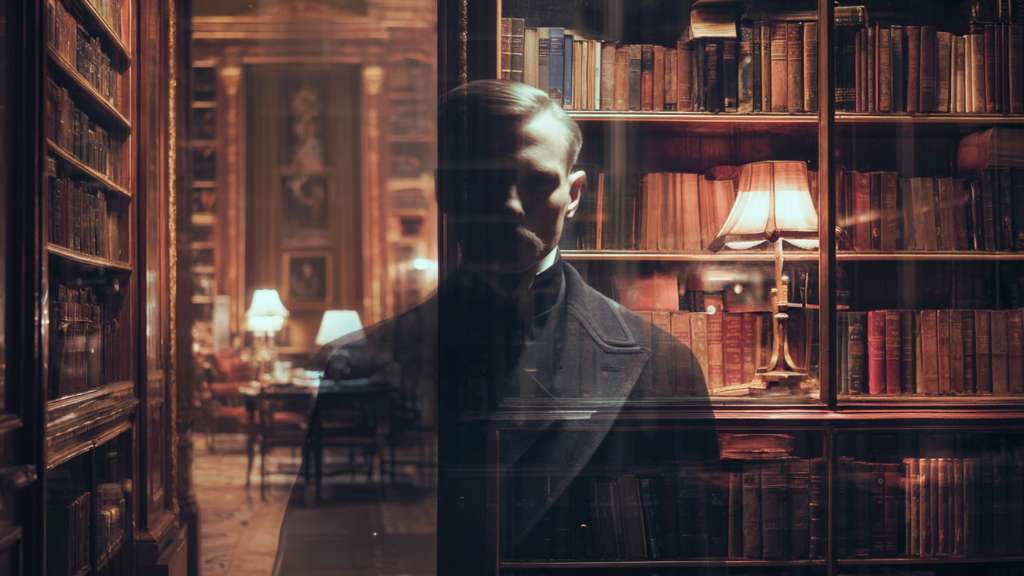
The library was older than its records suggested.
Its shelves rose higher than memory allowed, stacked with volumes whose spines had faded into uniform browns and umbers, as if language itself had slowly surrendered to dust. The air held a particular stillness, the kind that did not come from silence, but from agreement. Nothing moved here unless it had reason.
The figure crossed the floor without sound.
Not walking, not gliding, passing. Light caught the outline of a coat, then lost it again as the body blurred, as if the space itself refused to render him fully. Where he moved, the sunlight bent. Dust lifted, then settled more carefully, as though disturbed by something that no longer belonged to time.
He had once known his name.
That fact lingered with him like a word on the tip of the tongue, present, undeniable, and unreachable. The memory of having been someone mattered more than the details. Names were anchors. He had burned his.
Ashborn was not what he called himself. It was what remained after the last certainty collapsed.
He paused near the center of the hall, beneath a shaft of light that spilled from above and fractured across the polished floor. The books closest to him seemed darker, their edges absorbing illumination instead of reflecting it. Titles meant nothing now. The stories inside them had already chosen their endings.
Once, he had believed knowledge could save him.
He had come to places like this seeking explanation, coherence, a structure strong enough to hold what he had done and what had been done to him. But knowledge was not mercy. It was only accumulation. And accumulation, left unchecked, eventually collapsed under its own weight.
The fire had not been literal. Not entirely.
It had been a moment, an irreversible convergence of decision and consequence. A burning away of former alignment. When it ended, he was still standing, but the framework that defined him had turned to residue. What remained moved forward out of habit, not hope.
The library knew this.
Spaces like this always did.
That was why the light followed him imperfectly, lagging behind his motion, never quite settling on his form. He existed between classifications—no longer a reader, not yet an absence. His reflection did not appear in the polished wood. His footsteps refused to echo.
Somewhere in the upper galleries, a page shifted on its own.
He turned his head slightly, though he knew better than to search for cause. This place did not offer explanations. It offered recognition. That was enough.
He stood there longer than necessary, letting the sound beneath everything, the low, steady presence he carried with him, anchor his awareness. It was not a memory. It was not a voice. It was a rhythm that understood collapse and continuation as the same act.
Ashborn did not seek forgiveness. Fire does not ask what it leaves behind.
Eventually, he moved again, passing through the beam of light and leaving it intact, unchanged. The library exhaled quietly. The books remained closed. The dust settled.
Nothing here would record him.
That, finally, felt intentional.
Where this music fits best
Ashborn functions as a slow, atmospheric companion for moments of inner processing and liminal focus. It suits personal listening during reflection, late-night reading, emotional recalibration, or drifting states between concentration and rest. Beyond personal use, its restrained tension and textural depth make it well-suited as an underscore for cinematic scenes, introspective television sequences, narrative-driven games, or any visual medium that explores aftermath, identity erosion, and quiet transformation rather than overt action.