




















Liminal Thoughts – by Wartonno Sound / Dark Lofi Media

There is a moment – soft, fragile, almost imperceptible – when a dark ambient track stops being sound and becomes weight.
Not heaviness, but a strange gravity that doesn’t pull you down.
Instead, it lifts you – upward, sideways, inward – in a direction no compass could chart.
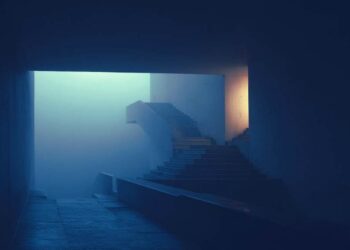
This sensation is what I call Night Gravity, the quiet phenomenon that makes liminal music feel like you’re floating through an abandoned concourse at midnight, or ascending through a stairwell that shouldn’t exist.
Liminal music is not just heard.
It is felt in the bones, as a shift in orientation, as if the world tilts by a few degrees and suddenly you’re falling upward into a softer dimension.
Why does this happen?
Why do certain frequencies, textures, and atmospheres trigger this sensation of upward drift?
Let’s explore.
The Murmured Physics of Liminal Sound
In traditional music, gravity is predictable – a force that resolves chords, anchors rhythms, and organizes movement.
But liminal music breaks those rules.
There is no downbeat.
There is no destination.
There is only suspension.
When your brain can’t find a rhythmic ground, it creates its own kind of weightlessness.
This is why dark ambient and liminal soundscapes often feel like floating in place:
- Long, unresolved drones mirror the sensation of a breath held.
- Soft noise layers mimic atmospheric pressure.
- Textural flourishes act like glimmers in the dark – faint but guiding.
You are not sinking.
You’re drifting.
You’re climbing through a direction that only exists in the dream architecture of the moment.
And yet, paradoxically, it feels grounding.
Like the world is quieter up here.
The Psychology of Falling Upward
Night Gravity activates a forgotten part of the mind – the part that responds not to melody, but to environment.
Humans evolved to read atmospheric cues:
- Distant rumbles
- Changes in air density
- The hush of vast, empty places
- The hum of machinery in the distance
- The layered drone of a place that shouldn’t be this quiet
Our nervous system interprets these cues as thresholds, not destinations.
Thresholds demand stillness.
Thresholds ask for reflection.
Thresholds give us permission to drift.
That’s what makes liminal music so potent for:
- reading
- journaling
- meditation
- focus
- dissociation
- emotional reset
The sound carries you upward, not outward – into a space where gravity feels optional.
The Architecture of Night Gravity
Liminal music carries a sense of place, even when no place is named.
It is architecture in the form of frequency.
You might feel like you’re in:
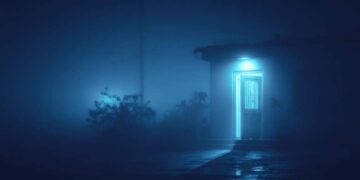
- an abandoned airport terminal
- a train station between schedules
- a hospital corridor with the lights dimmed
- a half-forgotten service tunnel
- a hallway from your childhood that you never walked through again
These locations are metaphors the mind constructs when it lacks context.
Night Gravity gives you height with no altitude and depth with no distance.
This is why so many listeners describe the same sensations:
- “It feels like floating in a place I’ve never seen.”
- “It feels like climbing a staircase made of air.”
- “It feels like sinking upward.”
Liminal soundscapes build environments that exist only when you surrender to them.
A Brief Listening Experiment
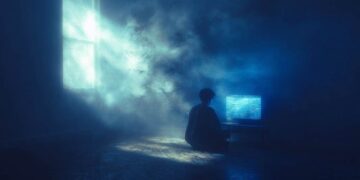
Put on a pair of headphones.
Choose a track that resonates with you.
I recommend this one from Wartonno Sound:
Astraveil
Because its silver-grain drones and distant PA ghosts embody Night Gravity perfectly.
Close your eyes.
Notice how the low frequencies don’t weigh you down.
They expand outward, like the floor beneath you widening.
Then the mid-high textures begin to shimmer – hints of upward pull.
Your awareness rises.
Your breath slows.
Your mind enters the threshold.
That’s Night Gravity.
The Meridian City Connection
— A Quiet Note From the Archive —
Rumors circulate through the lower levels of Meridian’s transit network:
The existence of a corridor that isn’t mapped, a place called The Ascender, though nobody agrees whether it goes up or down.
Witnesses describe:
“a tone that lifts behind your ribs,”
“a hallway that brightens the higher you step,”
“the feeling of being pulled upward, but the lights around you dim.”
Footage fails.
Maps refuse to update.
And the corridor disappears whenever the city’s central heartbeat resets.
Investigators believe the phenomenon isn’t spatial – it’s auditory.
A resonance that folds gravity inside-out.
Residents call it the sound of the city exhaling its memories.
Archivists simply call it:
Night Gravity.
Why We Seek This Weightlessness
We don’t listen to liminal music just for background ambiance.
We listen because it changes our internal physics.
Night Gravity offers:
1. Escape
A way to leave without leaving.
2. Emotional Neutrality
A space where nothing is demanded of us.
3. Soft Dissolution
The comforting disappearance of edges and expectations.
4. Permission to Drift
In a world that pressures us to anchor ourselves constantly.
Liminal music is the closest thing we have to a quiet ascent – a means of rising without effort, of moving upward without climbing.
Q&A — Understanding Night Gravity
Q: Is Night Gravity a mood or a musical element?
A: Both. It’s created through sound design but felt as a psychological shift.
Q: Does Night Gravity only occur in dark ambient music?
A: No. It appears in minimalism, isolationist ambient, dreamwave, and even slow cinematic scores.
Q: Why does it feel nostalgic?
A: Because liminal music evokes unnamed places – half-memories your brain fills in.
Q: Is Night Gravity good for meditation?
A: Extremely. The floating sensation encourages release and introspection.
Q: Can you experience Night Gravity without headphones?
A: Yes, but the effect is deeper when wrapped by sound.
Closing Reflection
Night Gravity is not a genre or a subculture.
It is a feeling – the quiet suspension of self, the gentle upward drift into a place without coordinates.
This is why we return to dark ambient soundscapes again and again.
Not to sink into darkness, but to rise into it.
To be held by a music that doesn’t force direction, but offers permission.
When the world grows loud, Night Gravity whispers:
There is another way to fall.
A softer way to ascend.
And in that moment, we are weightless again.