



























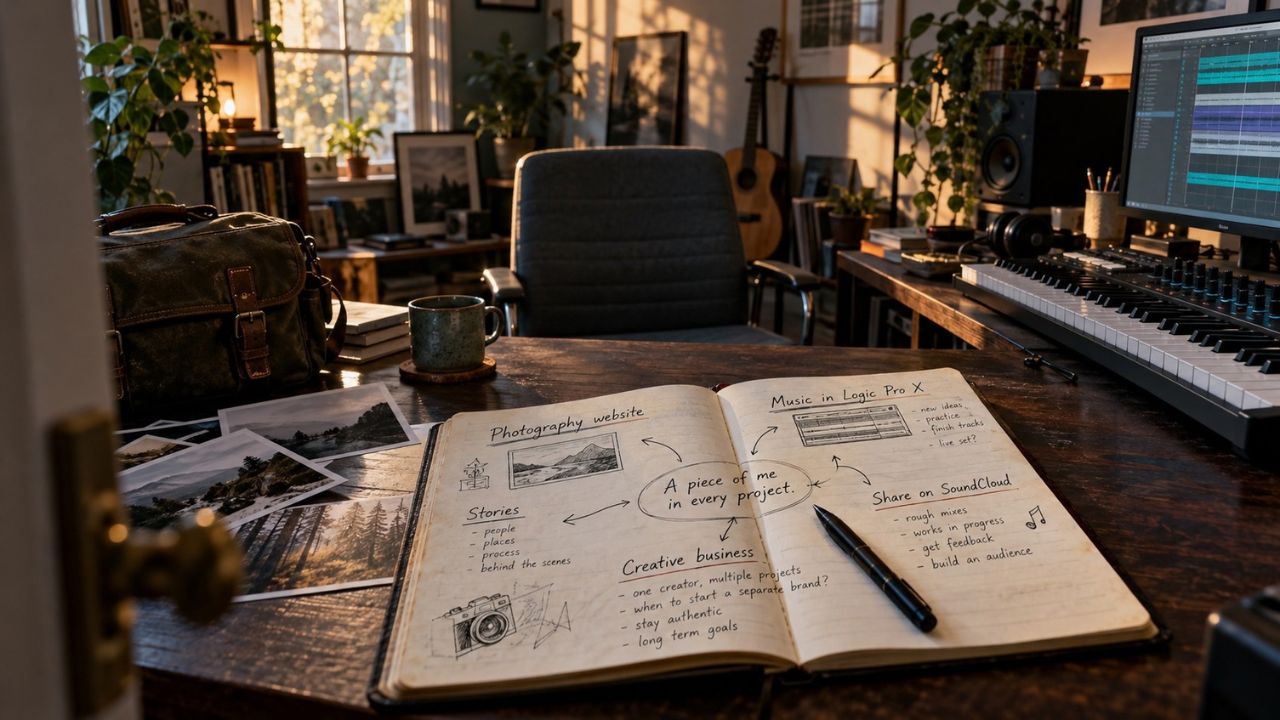
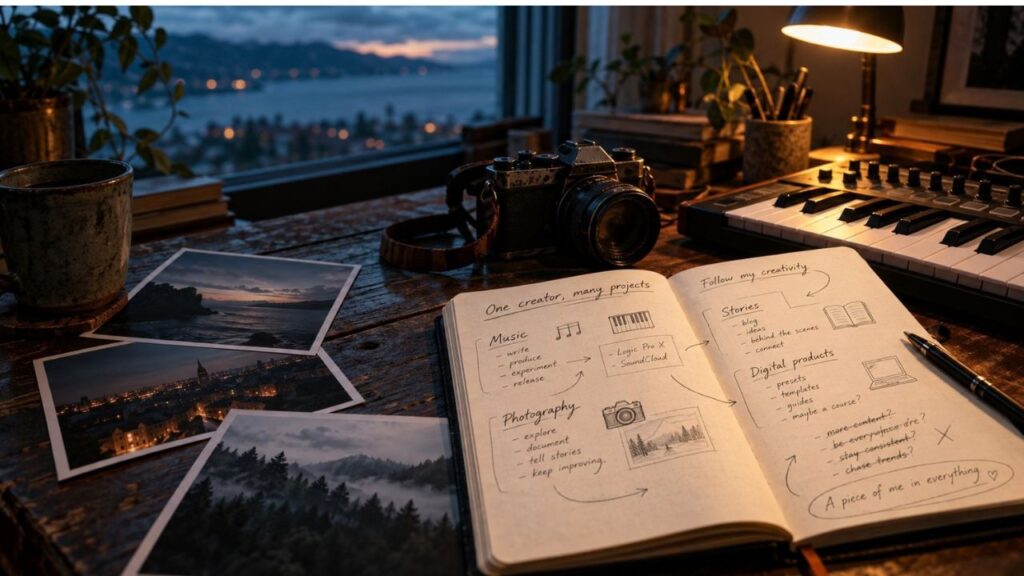
Some days, I feel more drawn to photography. I spend more time on the photography website and its social accounts. My attention moves toward images.
Other days, I want to make music. I open Logic Pro X, work on a track and add my music to SoundCloud.
I tend to follow what I feel like creating. I enjoy many different things, as long as they give me a way to be creative. I also want to combine that creativity with building a business.
That combination raises a practical question. If you make music, write fiction, take photographs and sell digital products, how many identities do you need?
A new interest can quickly suggest a new name. Then a website. Then social accounts. Each one offers the pleasure of a fresh beginning, along with another place that needs your attention.
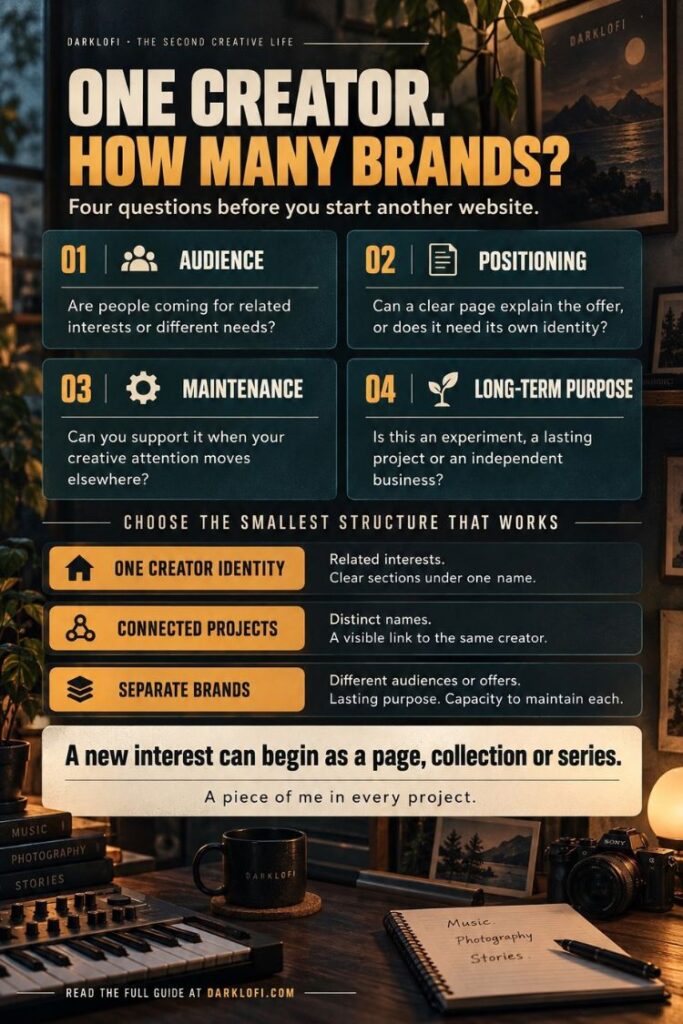
A separate brand makes sense when it serves a clearly different audience or offer, has a lasting purpose and can be maintained. When those differences are still uncertain, a project page, collection or named series inside your existing identity is a useful starting point.
The question I would start with is simple:
Does this project need a separate brand, or simply a clear place inside your existing creative world?
The mixture is part of who I am
I am drawn to a mixture. I do not expect everyone who follows me to enjoy every part of it.
People follow their own paths. Someone may connect with the music. Someone else may be interested in photography or stories. I like to think they find a piece of me in whatever I create.
That is the thread I want to keep visible.
It does not mean every project should look identical. A photography client needs different information from someone looking for an ambient track. A reader entering a fictional world needs a different introduction again.
But different introductions can still lead back to the same creator.
For me, the useful goal is a structure that makes the work easy to find while allowing that personal connection to remain. People should be able to choose the part that matters to them without needing to understand the whole arrangement first.
A project name does not require a separate business identity
Before deciding on another brand, it helps to distinguish three things.
A project is something you are making: an album, a photography series, a novella or a printable collection.
A named series or collection gives related work a recognisable place. It might have a title, cover style and dedicated page while staying under your creator name.
A separate brand gives an audience a distinct identity and expectation to return to. It may need its own explanation, presentation, customer communication and ongoing promotion.
These are practical working definitions. The boundaries can overlap, but the distinction helps you decide how much structure to build.
An album can have its own name without needing its own Instagram account. A photography series can have a different visual style without requiring a new website. A shop collection can address a specific use without becoming a standalone shop.
You can give an idea a clear identity in stages.
Three ways to organise several creative interests
There is more than one workable arrangement. These are the three I would consider first.
| Structure | How it works | When it is worth considering | Main responsibility |
|---|---|---|---|
| One creator identity | Music, writing, photography and products sit under one name, with clear sections. | Your point of view is the strongest connection and people can navigate the range easily. | Make each offer easy to understand. |
| Connected project identities | Projects have their own names and focused pages, with a visible connection to the creator. | The work needs different introductions but benefits from a shared personal thread. | Keep the relationship between projects clear. |
| Separate brands | Each project has a distinct public identity and audience promise. | The audiences, offers or long-term plans differ substantially. | Maintain each brand’s essential work and communication. |
My preference for a mixture points toward the middle option: a visible creator with room for distinct projects.
Wartonno.com already brings together music, Meridian City, journal writing and quiet tools. That shows one way different interests can have recognisable places within a broader creative world. It does not, by itself, prove that the arrangement produces more sales or that every visitor crosses between projects.
The right structure needs to work for the people using it and for the person keeping it alive.
1. Look at audience overlap through what people want
“Are these the same people?” is useful, but it is only the beginning.
Also ask: Are they coming here for a related experience or need?
Someone listening to atmospheric music while writing may also enjoy fiction with a similar mood. A listener who uses a track for a quiet evening might be curious about an accompanying reflection printable. These are plausible connections to test.
A person booking a photography session has a more immediate set of questions: what the photographs look like, where sessions happen, what is included and how to make contact.
They could enjoy your music too. That does not mean your booking page needs to explain your discography.
Audience overlap becomes more useful when you look for behaviour. Do people click from the music page to the story? Do readers ask about the soundtrack? Do customers understand an offer without repeated explanation?
Small numbers do not settle the question, but they can give you something more concrete than an assumption.
If you have little evidence, begin with a focused page inside your existing site. Give it a clear introduction and one relevant invitation. You can learn whether the connection helps before building more infrastructure around it.
2. Make the offer understandable in one sentence
A separate identity should help someone understand what they have found.
Try completing this sentence:
“This project offers ______ for people who want ______.”
For example:
- “This project offers atmospheric music for people who want a soundtrack for reading and late-night reflection.”
- “This photography service offers natural portraits for people who want photographs without formal posing.”
- “This collection offers printable reading journals for people who want to record and revisit their reading.”
These are examples of clear positioning, not promises about commercial results.
If you can write a distinct sentence, you have a reason to give the offer its own introduction. The next question is whether that introduction needs a separate name, page or full brand.
Sometimes a better menu label solves the problem. Sometimes a dedicated landing page does. A new identity becomes more useful when the existing name and presentation repeatedly make the offer harder to understand.
Separate branding cannot do all the work of a clear offer. A beautiful logo still leaves the visitor asking what you actually provide.
3. Count the maintenance during a quiet month
My creative attention moves. When I feel drawn to photography, that part of my work receives more time. When music becomes the stronger interest, I spend more time making music.
Any structure I consider needs to accommodate that movement.
A useful test is to imagine the project during a month when you would rather make something else. What still needs to happen?
For a portfolio, the essentials might be a working contact form, accurate information and a way to answer enquiries. For a shop, they might include customer questions, working downloads and clear product details. For a music project, the public home may remain useful between releases without a daily stream of posts.
Fresh content and essential maintenance are different responsibilities.
You can choose a gentle publishing pace. You still need to meet the commitments attached to what you offer.
Here is a hypothetical time budget. It is an illustration, not a claim about how long your tasks will take:
| Weekly task for an additional brand | Example time |
|---|---|
| Prepare one useful update | 45 minutes |
| Answer messages and enquiries | 30 minutes |
| Check pages, links or product details | 30 minutes |
| Decide and organise the next action | 15 minutes |
| Total | 2 hours |
At that pace, three additional brands would use six hours a week before counting the creative work itself. Your actual requirements may be lower or much higher.
Write down your own minimum. Include recurring costs such as a domain or paid service if you would genuinely need them.
This is where Why Your Second Creative Life May Need Less Screen Time becomes relevant. When you plan a new public presence, leave room for the activity that made you want it in the first place.
4. Decide what you want the project to become
A personal experiment and a lasting commercial offer need different levels of commitment.
Perhaps you want to explore a new sound for a few tracks. Perhaps you want to build a photography service you will still enjoy running in three years. Perhaps a product line could eventually involve collaborators and develop an identity beyond your own name.
Each possibility suggests a different structure.
A separate brand is more worth considering when you can describe a durable role for it. That might mean a recognisable product range, a specific service or a project intended to develop independently of your broader creator identity.
If you are still discovering what the work is, a series or collection leaves room to learn.
For creators beginning something new later in life, that room matters. You may have plenty of experience while still being a beginner in this particular medium. From Expert to Beginner Again explores that transition.
You are allowed to learn what a project needs by making it. The entire identity does not have to be settled before the first piece exists.
A practical separate-brand decision framework
Use these questions for one project at a time. This is a planning aid, not a validated scoring system.
| Question | A reason to keep it connected | A reason to consider separation |
|---|---|---|
| Who is it for? | The audience has related interests or needs. | The intended audience comes for something substantially different. |
| What does it offer? | A clear section or collection explains it well. | The current presentation repeatedly creates confusion. |
| What must be maintained? | Shared pages and channels cover the essentials. | You can reliably support the additional work a separate presence requires. |
| Where is it going? | It remains an experiment or part of your personal creative practice. | It has a lasting purpose that benefits from an independent identity. |
Do not treat the table as a majority vote. A distinct audience is not enough if you cannot support the resulting workload. Equally, a shared audience does not rule out separation when the offers need very different presentations.
My practical recommendation is to use the smallest structure that makes the offer clear and lets you keep your commitments.
That might be a page today, a named collection later and a separate brand once the reason becomes stronger.
Give a new idea a small public test
Before creating a full set of channels, try a limited version of the project.
Choose one offer or body of work. It might be three photographs, a short music collection or one digital product. Create a page explaining what it is and who it is for. Share it through a relevant existing channel.
Then set a review point, perhaps after a month or after a small release cycle. The timing is your choice. It should give you a chance to make and share something meaningful without turning the test into a permanent obligation.
Ask what you learned:
- Did people understand the offer?
- Was the connection to your existing work helpful or confusing?
- What did people actually ask, click, buy or return to?
- How much work did maintaining the project require?
- Do you still want to develop it after the initial excitement?
If the response is limited, you may need more time or a better way to reach the intended audience. A quiet test does not automatically mean the project is wrong.
The purpose is to gather information before making a larger commitment.
Creative freedom needs clear commitments
Following your interest can help you return to the work with energy. It also becomes more complicated when other people are relying on a result.
The distinction I would keep clear is between where creative attention moves and what has already been promised.
You can spend more of your creative time on music this month while keeping a photography contact page accurate. You can pause a personal series while completing an agreed commission. You can leave a finished collection available without inventing weekly updates for it.
An approach worth trying is to choose one main creative focus for the current period, then list the small maintenance tasks that protect the other projects’ commitments. Review it when your attention shifts.
That connects with Too Many Creative Projects? A Simple System for Deciding What to Work On. That article uses project status to manage attention. This one adds a separate decision: how much public identity each project needs.
You do not have to give every project equal time for each one to have a clear place.
People can follow one part and still feel connected
I expect people to follow their own interests. I would like the people who enjoy my work to find a piece of my creativity in whichever part they choose.
That leaves room for different relationships.
Someone may only listen to the music. Someone may only read the articles. Someone may move between several projects because the atmosphere or point of view feels familiar.
I do not need to assume that everyone wants the whole collection.
For a creator with several interests, a main website can offer an overview while focused pages help people find what they came for. Related projects can be introduced where the connection is useful. Separate updates or mailing-list choices can let people express what they want to hear about, if maintaining those choices is practical.
A shared identity can be visible without occupying every conversation.
Questions about managing multiple creative brands
Should a musician and photographer use the same brand?
They can, especially when the creator’s name is the main connection. Give listening and booking visitors clear routes. Consider a separate identity when the audiences or offers are hard to explain together and there is capacity to maintain it.
Does every creative project need its own website?
No. A page, portfolio section, playlist or shop collection can provide a focused home. A separate website becomes useful when it solves a specific navigation, presentation or operational need.
Will several interests confuse my audience?
They can if visitors struggle to understand what is offered or where to go. Clear introductions and navigation help. Look for actual questions and behaviour before assuming your range is the problem.
How many brands can one creator manage?
There is no useful universal number. Workload depends on what each brand promises, how it operates and what support is available. Estimate essential maintenance and delivery work before adding another identity.
Can a project start under my name and become separate later?
Yes. Starting with a page or named series gives you room to test the offer. If you separate it later, explain the connection and give existing followers a clear route to its new home.
Can creativity and business work together when my interests shift?
They can, provided the business commitments remain manageable and are met. Your creative focus can change while contact information, customer support and agreed delivery remain dependable. Choose offers that fit the capacity you actually have.
For me, the mixture remains part of the point. Photography, music and the other things I make are ways of expressing the same curiosity.
The camera can rest beside the keyboard. One may receive more attention today. Both still belong in the room.
Which part of your creative world needs its own front door, and which simply needs a clear place inside?