
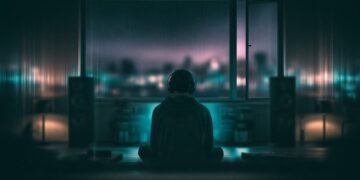
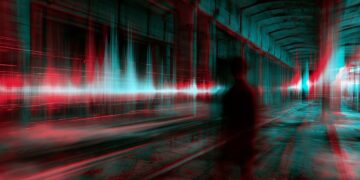













There is a moment before sleep when the mind begins to dream, but a small part of us is still listening to the world.
Sometimes it starts with an image.
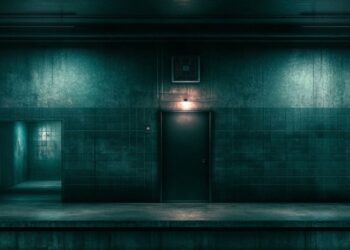
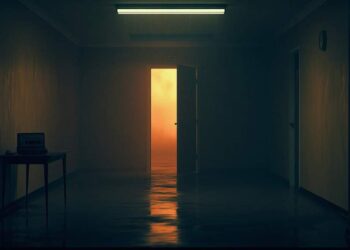
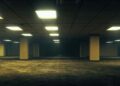
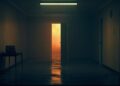
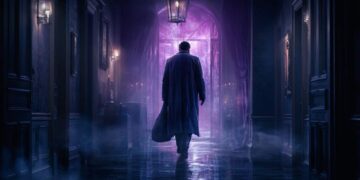
A room you have never visited. A face that disappears before you can recognize it. A corridor stretching into darkness, or a voice calling a name you almost remember.
You open your eyes.
The bedroom is familiar again. The ceiling has not changed. Somewhere outside, a car passes through the night.
But for a brief moment, you were somewhere else.
There is a name for this strange space between waking and sleeping.
Hypnagogia.
And although it may feel mysterious, it is a surprisingly common part of the human experience.
What Is Hypnagogia?
Hypnagogia is the transitional state between being awake and falling asleep.
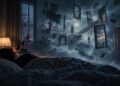
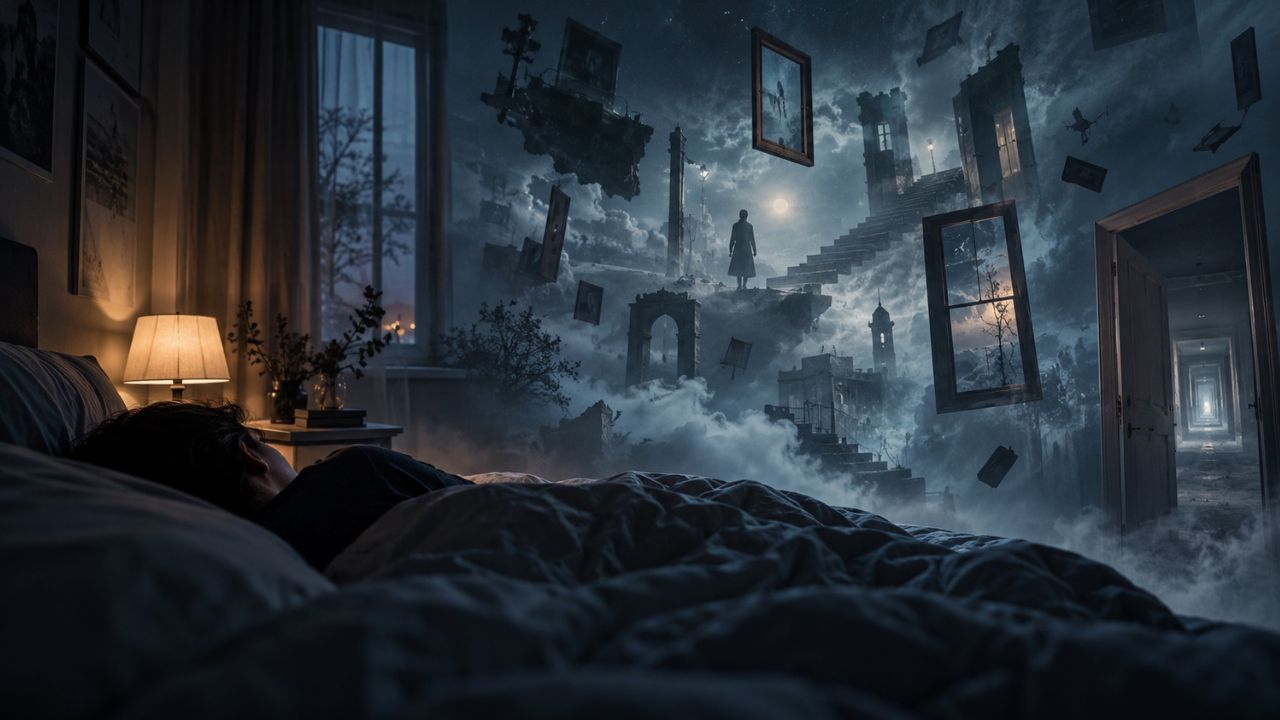
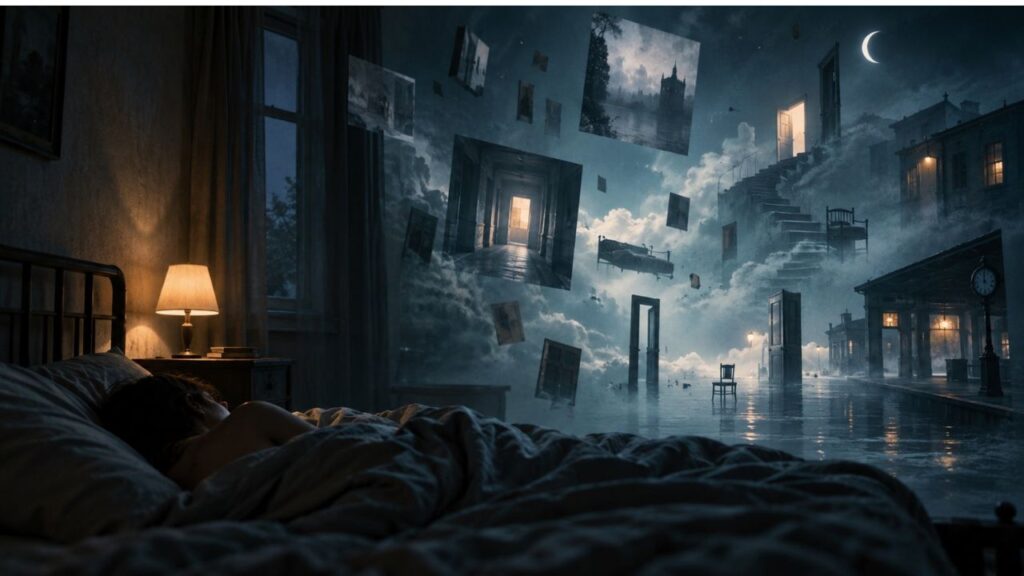
During this period, your awareness of the room around you gradually changes. Thoughts become less organized. Images may appear without warning. Sounds, sensations and fragments of imagined places can briefly feel almost real.
You are not quite dreaming in the familiar sense. But you are no longer thinking in the same way you did a few minutes earlier.
The boundaries are beginning to soften.
Scientists associate this transition with the earliest stages of sleep, including a stage known as N1. During this period, the brain moves away from ordinary wakefulness, and brief dreamlike experiences can begin to appear.
Not everyone remembers these moments. Some people experience them as vague thoughts or flashes of color. Others notice remarkably vivid scenes.
And sometimes, the whole experience disappears the instant they become fully awake again.
Why Do We See Strange Images Before Falling Asleep?
One of the most fascinating aspects of hypnagogia is the appearance of images that seem to arrive without conscious effort.
You might see:
- Faces of people you cannot identify.
- Geometric patterns, lights or shifting colors.
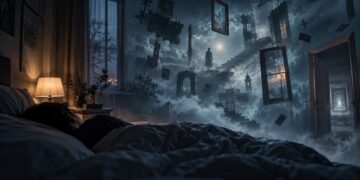
- Rooms, staircases or unfamiliar buildings.
- Landscapes that feel strangely familiar.
- Brief scenes that disappear as quickly as they arrive.
These experiences are sometimes described as hypnagogic imagery or, when they have the quality of a perception without a corresponding external stimulus, hypnagogic hallucinations.
The word hallucination can sound unsettling, but in this context it does not automatically suggest something is wrong.
Sleep-related hallucinations are relatively common and, when limited to the transition into sleep, are usually harmless.
Researchers are still investigating exactly how they arise. What we know is that perception, awareness and internally generated imagery can interact in unusual ways as the brain moves toward sleep.
For a few moments, an image can feel less like something you are imagining and more like something you are seeing.
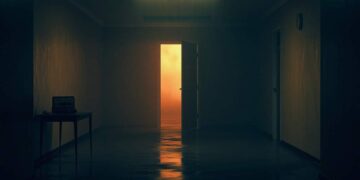
A door appears.
Then a hallway.
Then nothing.
Hearing Sounds That Are Not There
Hypnagogia is not only visual.
Some people hear sounds as they drift toward sleep.
A short piece of music. A distant conversation. Someone speaking a single word. A door closing somewhere in an imaginary building.
Occasionally, these sounds feel surprisingly distinct.
You may even open your eyes to check whether something actually happened.
Auditory hypnagogic experiences are another recognized form of sleep-onset imagery. Like the visual experiences, they are usually brief and do not necessarily indicate an underlying condition.
There is something especially interesting about this for those of us who work with sound.
During the day, we actively listen to music, voices and the atmosphere around us.
At the edge of sleep, the mind can begin creating its own sounds.
Not a finished composition.
Just fragments.
A tone with no clear source. A distant rhythm. An echo belonging to a place that exists only for a few seconds.
And perhaps that is what makes these experiences so memorable when we manage to remember them at all.
The Strange Places We Visit Before Sleep
Some hypnagogic images are abstract.
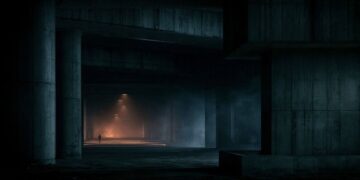
Others seem almost architectural.
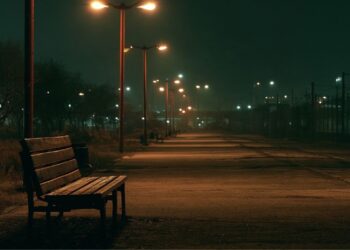
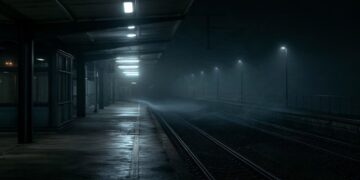
A staircase. A forgotten hotel. A train platform without passengers. A room that looks like somewhere from childhood, except the windows are in the wrong places.
These are examples of the kinds of imagined scenes someone might experience, not symbols with fixed psychological meanings.
Yet there is a particular feeling that can accompany them.
Recognition without explanation.
You have never been there.
But something about the place feels familiar.
This sensation also appears in dreams, memory and the atmosphere of what we often call liminal spaces: places that seem to exist between one state and another.
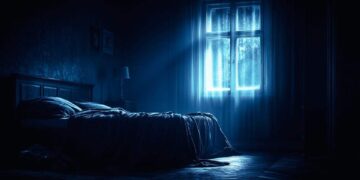
An empty corridor can feel different from the same corridor filled with people. A bedroom at three in the morning can seem detached from the ordinary world.
Hypnagogic imagery can create a similar atmosphere within the mind.
A space appears, holds our attention briefly, and disappears.
We are left not with a story, but with the feeling of having been somewhere.
Why Hypnagogia Feels Different From an Ordinary Dream
Most of us associate dreaming with scenes that unfold while we are asleep.
There may be people, conversations, places and events. Even when the story makes little sense, it can feel complete while we are experiencing it.
Hypnagogic experiences are often less structured.
Instead of a story, you may notice a single image.
Instead of a conversation, one unexplained voice.
Instead of a journey, the sensation that you were suddenly standing in an unfamiliar room.
The distinction is not absolute. Dreamlike experiences can begin during early sleep, and the boundary between sleep-onset imagery and dreaming is not always sharp.
But the fragmentary nature of hypnagogia is part of what makes it interesting.
It does not always give us enough time to understand what we have seen.
And perhaps we do not need to.
Some experiences can remain unfinished.
Can Hypnagogia Influence Creativity?
The boundary between waking and sleeping has interested artists and creative thinkers for generations.
There is a reason for this.
In our fully awake state, we often try to organize our thoughts. We evaluate ideas, decide whether something makes sense, and turn impressions into recognizable forms.
During sleep onset, thoughts and images can become less constrained by ordinary expectations.
A familiar object may appear in an unfamiliar setting. Two unrelated ideas may briefly connect.
Research suggests that the earliest stage of sleep may have a relationship with creative insight.
In a 2023 study discussed by the U.S. National Institutes of Health, researchers found that brief periods of sleep onset, particularly when accompanied by dream content related to a problem, could support certain kinds of creative thinking.
That does not mean falling asleep will automatically produce better ideas.
Nor does it mean every strange image has hidden significance.
But it suggests that the moments just before sleep may sometimes provide access to unusual associations.
For a composer, that might be a melodic shape.
For a writer, a sentence that arrives unexpectedly.
For a photographer, an image that feels impossible to recreate.
For someone who simply enjoys quiet moments, it may be nothing more than a glimpse into the mind’s changing relationship with the world.
And that is enough.
The Connection Between Hypnagogia and Ambient Music
Music can create a gentle setting for reflection as the day comes to an end.
Ambient music is especially interesting in this context because it does not always demand active attention.
A sustained note can change so slowly that you hardly notice it.
A distant texture can resemble wind moving through an empty building.
A melody may appear for a moment and then dissolve into silence.
These qualities can resemble the fragmented, shifting nature of sleep-onset imagery.
Of course, listening to ambient music does not guarantee hypnagogic experiences, deeper sleep or more vivid dreams.
And not everyone prefers sound when falling asleep.
But for those who enjoy quiet listening, an atmospheric composition may provide a space in which the mind can gradually release its attention from the demands of the day.
You do not have to follow the music.
You can simply allow it to be there.
A Soundscape for the Space Between Thought and Sleep
Listening companion — Wartonno Sound
Some sounds feel as though they belong to an empty room.
Others seem to come from somewhere beyond it.
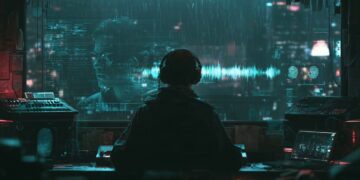
For this Dream Fragments article, I invite you to explore a quiet ambient soundscape from Wartonno Sound: something slow, spacious and without a strong rhythmic demand.
Not music intended to control what you dream.
Simply a place to listen while the evening becomes quieter.
Wartonno Sound track – Fading Signal
How to Remember a Hypnagogic Image
One of the difficulties with sleep-onset imagery is how quickly it can disappear.
A moment ago, you were looking at an extraordinary building.
Now you cannot remember what it looked like.
Only that it felt important.
If you find these experiences interesting, you might try keeping a small notebook beside your bed.
There is no need to turn it into a complicated practice.
Start with three simple observations.
1. What did you notice?
A face, a room, a sound, a color, a strange sensation.
Write down whatever remains, even if it is only a single word.
2. What did it feel like?
Familiar, peaceful, confusing, unsettling, distant or strangely beautiful?
Sometimes the atmosphere remains longer than the image.
3. What detail do you still remember?
Perhaps the room had no doors.
Perhaps there was a sound coming from behind a wall.
Perhaps you remember nothing about the place except the light.
You can write down that one detail and leave everything else unfinished.
There is no need to interpret every experience.
And certainly no reason to disrupt your sleep just to collect fragments. Rest matters more than remembering.
If you naturally wake with an image still in your mind, perhaps that is enough of an invitation to write it down.
Free Printable: Before the Dream Disappears
Sometimes, all that remains of a dream is a single image, a distant sound, or a feeling you cannot quite explain.
I created a simple, one-page Dream Fragment Reflection Sheet to give those fleeting memories somewhere to stay.
It includes space to write down what you saw, what you heard, how it felt, and the small details you still remember. There is also room to sketch a place or image that words cannot quite describe.
[Download Your Free Dream Fragment Reflection Sheet (A4 PDF)]
No sign-up required. Just a quiet page for the things you almost remember.
A Small Dream Fragment
The corridor had no ending.
I remember walking toward a window, although I could not see what was outside.
There was music coming from somewhere behind the walls.
Not loud enough to recognize.
Only a few notes, repeating slowly.
I knew I had been there before.
Then the room changed.
And I was awake.
Perhaps you recognize something in this little scene.
Not the corridor itself.
But the feeling of a place that disappears before you can understand it.
That is part of what Dream Fragments is about.
The pieces of our inner lives that do not quite become stories.
When Should You Be Concerned About Sleep-Onset Experiences?
Although hypnagogic hallucinations are often harmless, they can sometimes be distressing or occur alongside sleep disorders.
If these experiences frequently interrupt your sleep, cause significant fear, or happen alongside excessive daytime sleepiness, speaking with a healthcare professional is sensible.
The same applies if you experience unexplained hallucinations while fully awake.
There is a difference between a fleeting image at the edge of sleep and a persistent experience that affects your waking life.
Understanding that distinction can make the experience less confusing.
A Place for the Things We Almost Remember
We spend so much of our waking lives trying to make sense of things.
Finding explanations.
Connecting ideas.
Turning fragments into complete stories.
But hypnagogia reminds us that the mind does not always work that way.
Sometimes it gives us a room without a door.
A voice without a speaker.
A landscape without a name.
And then it lets them disappear.
Perhaps there is something quietly beautiful about that.
Not every image needs to be preserved.
Not every strange place needs an explanation.
Some things belong to the space between thought and sleep.
And sometimes, for a few seconds, we are allowed to visit.
Continue Exploring Dream Fragments
If you find yourself remembering strange rooms, forgotten voices or places that seem to exist only at night, the Dream Fragments Journal is a place to explore those experiences.
You may also enjoy keeping a small record of your own dream imagery.
Coming to the Dream Fragments collection: a printable Between Sleep & Thought reflection page for recording the images, sounds and feelings that linger after waking.
Part of Dark Lofi Journal — Dream Fragments.
[Download Your Free Dream Fragment Reflection Sheet (A4 PDF)]
Sources and Further Reading
- Cleveland Clinic — Hypnagogic Hallucinations: Causes, Symptoms & Treatment
- Ghibellini, R. & Meier, B. — The Hypnagogic State: A Brief Update, Journal of Sleep Research (2023)
- National Institutes of Health — Quick Catnaps May Spark Creativity (2023)
- Sleep Foundation — Hypnagogic Hallucinations
Editorial note: This article explores sleep-related experiences for educational and creative purposes. It is not medical advice.
What is hypnagogia?
Hypnagogia is the transitional state between wakefulness and sleep, during which people may experience brief dreamlike images, sounds or sensations.
Is it normal to see images before falling asleep?
Yes. Brief visual experiences during sleep onset are relatively common and are usually harmless.
Can hypnagogia involve hearing music or voices?
Yes. Some people experience short auditory impressions, including music, voices or other sounds, while falling asleep.
Is hypnagogia the same as lucid dreaming?
No. Hypnagogia occurs during the transition into sleep, while lucid dreaming involves recognizing that you are dreaming during a dream.
The definitions and safety distinctions are supported by Cleveland Clinic and Sleep Foundation.