















Creativity, resistance and finding focus after 50
There comes a point when the question is no longer whether you are creative.
You already know that you are.
The harder question is what to do with all the things you still want to create.
After the age of 50, I began to notice something about myself. Starting a project was rarely the problem. I could find an idea, feel the energy around it and begin building something almost immediately.
Finishing was more difficult.
There was always another direction waiting nearby. Another piece of music. Another story. Another visual idea. Another project that seemed just as meaningful as the one already in front of me.
This section of Dark Lofi is about that tension.
It is about creative Resistance, but also about curiosity. It is about returning to old interests, beginning new ones and trying to find enough focus to complete the work that matters.
It is for people who feel that an important part of their creative life may still be ahead of them.
The work does not disappear
Some interests leave for a while, but they do not always disappear.
Music was part of my life when I was a teenager. I played in a band, but eventually stopped as family life and other responsibilities became more important.
For a long time, making music belonged to an earlier version of me.
Now the technology has changed. A musician no longer needs a complete studio, a large team or access to expensive equipment. It is possible to compose, record, produce and master music independently.
The instruments may be digital, but the reason for creating remains personal.
Returning to music did not feel like starting from nothing. It felt more like reopening a room that had been closed for many years.
The room was still there.
It was simply waiting.
Photography as a way back
Photography was also part of my earlier working life. I used it for a marketing business, but stopped when the digital era began to change the field.
Years later, after my mother became ill and died, I returned to photography.
This time, it was not primarily for business.
It became a form of therapy.
Photography gave me a reason to look outward when much of my attention had turned inward. It created small moments of stillness. A landscape, an empty street, a building or a particular quality of light could hold my attention for a while.
The camera did not remove grief.
It gave grief somewhere to breathe.
That experience taught me that a creative practice does not always return in the same form or for the same reason. Something that once belonged to work can later become a way of processing life.
A creative interest may appear to have ended, while it is really waiting for a different purpose.
The stories that waited
Writing is something I always wanted to do.
For many years, there never seemed to be enough time. Writing a book felt distant, complicated and difficult to fit around the rest of life.
That has changed too.
Today, it is easier to begin writing, format a manuscript and publish work independently. The practical barriers have become smaller, even though the emotional barriers remain.
Publishing a book does not guarantee that many people will read it.
At the moment, I am still working on finding those readers.
But a quiet audience is not the same as failure.
A book can exist before it is discovered. A piece of music can be meaningful before it has many listeners. Creative work often begins in silence.
The challenge is continuing long enough for the work to find its place.
Starting teaches you something
Starting many projects is often described as a weakness.
Sometimes it is.
A new project can become a comfortable escape from the difficult middle of the current one. The beginning is full of possibility. The middle asks for decisions. The ending asks us to let the work become real.
But starting also teaches us.
Every project leaves something behind:
- a new technical skill;
- a clearer sense of taste;
- a better understanding of what matters;
- a lesson about what we do not want to make;
- a fragment that may belong inside a future project.
Not every beginning is wasted.
The problem begins when we use new beginnings to avoid every ending.
That is one of the questions I want to explore here:
How do you remain curious without allowing curiosity to scatter your attention?
When Resistance changes its voice
Steven Pressfield writes about Resistance as the force that appears between the creator and the work.
When you are younger, Resistance may tell you that you do not have enough experience.
Later in life, it may use a different voice.
It may say:
- You should have started earlier.
- Other people are already too far ahead.
- You do not understand the new technology.
- You have too many unfinished projects.
- You are too old to build an audience.
- Nobody is waiting for another book, photograph or piece of music.
- There is not enough time left to make the work successful.
These thoughts often sound practical.
That is what makes them convincing.
Resistance rarely announces itself as fear. It prefers to sound reasonable.
After 50, it can use your awareness of time against you. It can turn experience into regret and caution into immobility.
But age also brings something Resistance does not like.
You know more clearly what loss feels like. You understand that time is limited. You may no longer be as interested in appearing impressive. You have experienced work, responsibility, disappointment, love and change.
That is not creative baggage.
It is creative material.
Too many interests, one life
I like many things.
Music, photography, writing, visual ideas, publishing and building creative worlds can all hold my attention.
For a long time, I thought focus might require choosing only one of them.
I no longer believe that is completely true.
You do not necessarily need to choose one passion for the rest of your life.
But you may need to choose which passion receives your best attention now.
That is a different kind of focus.
It does not ask you to destroy your other interests. It asks you to place them somewhere safe while one project moves forward.
Perhaps the real choice is not:
Which part of myself must I abandon?
Perhaps it is:
Which part of my creative life is in season?
Some projects need daily attention.
Some need to wait.
Some may support each other. Music can create the atmosphere for a story. Photography can shape a visual world. Writing can give language to a piece of music.
The interests are not always the problem.
The absence of hierarchy is.
A seasonal creative focus
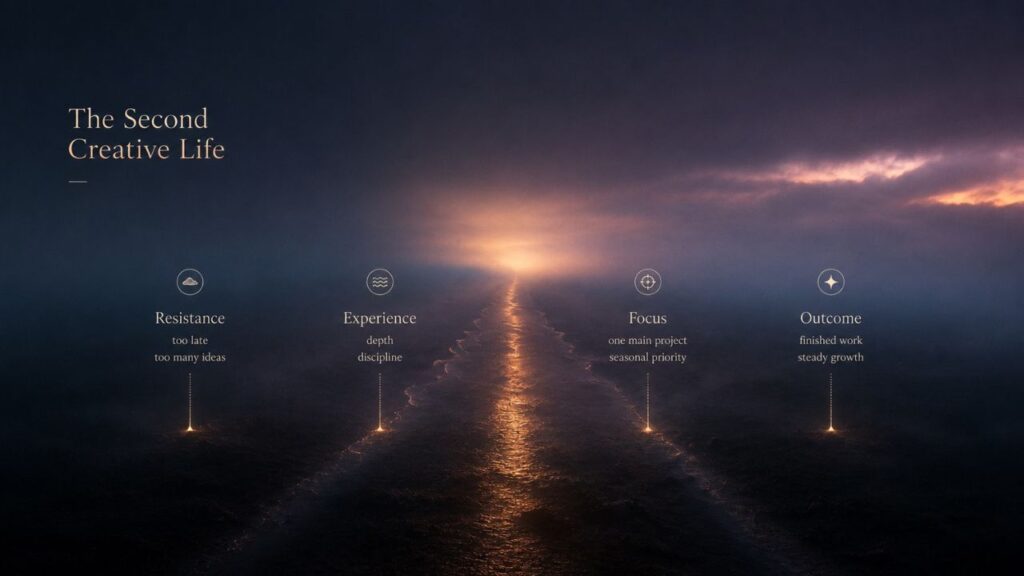
One of the ideas behind The Second Creative Life is simple:
You can have many interests, but not every interest can be your main project at the same time.
A seasonal focus gives one project permission to become primary for a defined period.
That period may be a month, a season or the time required to finish one meaningful piece of work.
During that period, your creative life might contain:
One primary project
This receives the clearest deadlines and your best available energy.
It could be:
- finishing a book;
- completing an album;
- publishing a series of photographs;
- building a body of essays;
- developing one coherent creative platform.
One supporting practice
This helps the main project without competing with it.
Music might support writing. Walking with a camera might create space for reflection. Short journal entries might help clarify a larger project.
One place for everything else
New ideas do not need to be rejected.
They need somewhere to wait.
An idea archive, notebook or project list can preserve them without allowing each new idea to interrupt the work already underway.
This is not a perfect system.
It is a way of creating enough quiet around one project for it to reach the end.
From beginning to completion
Finishing requires a different energy than starting.
The beginning is imaginative.
Finishing is editorial.
It asks:
- What belongs here?
- What can be removed?
- What is good enough to release?
- Which imperfections must I accept?
- What will I learn only by publishing?
A finished project can be judged.
An unfinished project remains full of potential.
That is why unfinished work can feel strangely safe.
To finish means allowing the imagined version of the project to become an actual book, song, article or image. The result may be smaller than the original dream.
But it will exist.
And completed work can travel further than perfect intentions.
What I am trying to build
My own goals are concrete.
I want to sell more books.
I want to build and maintain a steady daily audience for my music.
These goals matter because I do not only want to create privately. I want the work to reach people.
At the same time, numbers can become another form of Resistance.
A small number of readers can make writing feel pointless. A quiet day on a music platform can make the work feel invisible. Slow growth can tempt us to change direction before the current direction has been given enough time.
This is another tension I want to explore honestly.
Creative work needs patience, but a creative career also needs strategy.
Making and marketing are not the same activity, but both require attention.
The aim is not to become consumed by statistics.
The aim is to create work worth discovering and then make it easier for the right people to find it.
What you will find here
The Second Creative Life will explore the practical and emotional realities of creating after 50.
Topics will include:
Creative Resistance
How fear, perfectionism, regret, distraction and self-doubt prevent meaningful work from being completed.
Focus for people with many interests
How to work with curiosity without constantly abandoning one project for another.
Returning to old creative identities
What happens when you return to music, writing, photography or art after many years away.
Beginning again with modern tools
How technology, independent publishing and digital platforms can reopen doors that once appeared closed.
Finishing creative work
How to move through the difficult middle and release work without waiting for complete confidence.
Sustainable creative discipline
How to build a rhythm around your actual energy, health, work and responsibilities instead of copying hustle culture.
Finding readers and listeners
How to share books, music and other work without turning creativity into constant self-promotion.
Meaning and legacy
What we want to create with the experience, time and attention we still have.
This is not a late hobby
Creativity after 50 is often presented as a pleasant pastime.
Something to keep you occupied.
Something to try after the serious part of life is over.
I do not see it that way.
The work may be quieter now, but it can also be deeper.
You may understand your themes more clearly. You may know what you no longer want to pretend. You may have fewer illusions about success, but a stronger reason to continue.
You are not beginning with nothing.
You are beginning with decades of memory, work, disappointment, love, skill and observation.
The task is not to become young again.
The task is to use what time has given you.
A place to begin again
This section is not written from the perspective of someone who has solved every problem of focus, finishing or audience growth.
I am inside the process too.
I am still learning how to choose between ideas.
I am still working on completing projects.
I am still trying to reach more readers and create a steady audience for my music.
That is why this space exists.
Not as a collection of final answers, but as a record of the attempt.
A place to examine Resistance without giving it the last word.
A place to take curiosity seriously without letting it pull everything apart.
A place for the person who has lived long enough to know that time matters, but who still feels something unfinished moving beneath the surface.
Perhaps your creative life did not arrive too late.
Perhaps it was gathering material.
And perhaps this is the season in which some of that material is finally given a form.
You do not need to choose one passion for the rest of your life. You need to choose one primary project for this season. Start here!