






















You can listen to the same ambient track in two different places and hear what feels like two different pieces of music.

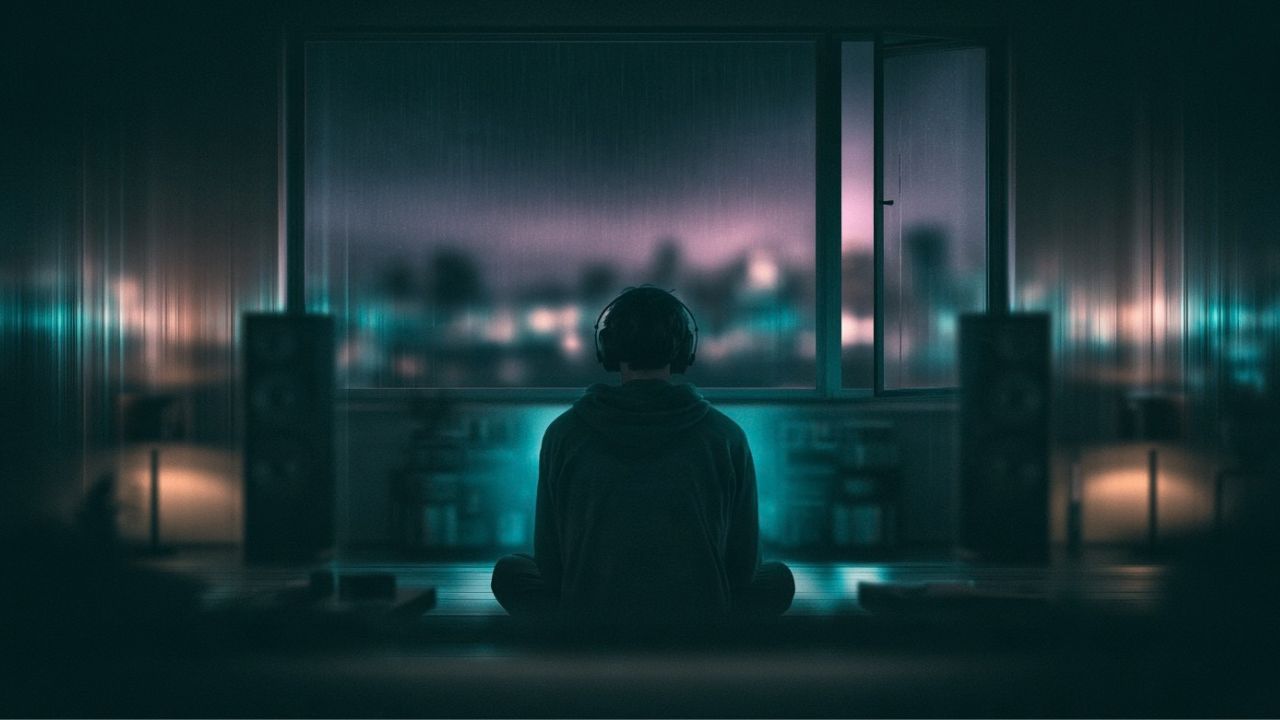
Play it through headphones in bed at 1AM and it may feel private.
Play it through speakers in a large empty room and it may suddenly feel enormous.
Listen while walking through rain and the street begins to merge with the recording.
Play it quietly while people talk in the next room and parts of the music seem to disappear.
The file has not changed.
The recording has not changed.
But your experience has.
That is because you are never listening only to music.
You are listening to:
the recording + the playback system + the room + the sounds around you + the moment you are in.
For ambient music, that combination can matter more than we usually notice.
Why does ambient music feel different depending on where you listen?
Because the listening environment changes both the sound and the experience. Room acoustics, background noise, headphones or speakers, time of day and surrounding activity can affect perceived space, detail, immersion and emotional context. With ambient music, these environmental elements can become part of the listening experience itself.
The Room Is Part of the Music
Most of us think about a room as the place where listening happens.
But acoustically, the room participates.
Sound leaves a speaker, reaches you directly, and also reflects from walls, floors, ceilings, windows, furniture and everything else around you.
Those reflections affect how spacious, close, soft or distant the music feels.
Research into spatial audio has found that different listening rooms can change perceived immersion, and that reverberation can increase the sense of immersion under some playback conditions. Aalto University’s research portal
That does not mean you need an acoustically perfect studio to enjoy ambient music.
Almost the opposite.
An imperfect room can become part of the character.
A small bedroom absorbs and contains sound.
A tiled room reflects it.
A large church lets notes hang in the air long after they were played.
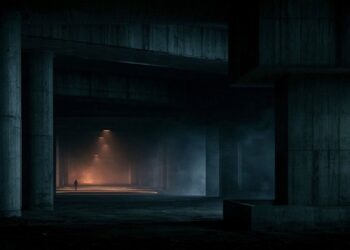
An empty industrial space creates another experience entirely.
The room does not simply hold the music.
It answers it.
Ambient Music Leaves Room for the Room
This happens with every genre, but ambient music makes the effect particularly noticeable.
Dense music can fill most of the available acoustic space.
Ambient often does something different.
A drone appears.
Then nothing happens for several seconds.
A distant texture moves.
A note fades.
There is space between events.
That space creates openings where the physical environment becomes audible.
A heating system.
Traffic outside.
Rain on the window.
Floorboards upstairs.
Wind.
Someone closing a door somewhere else in the building.
Instead of always competing with the recording, these sounds can begin to feel as though they belong inside it.
The boundary becomes unclear.
Where does the track end?
Where does the room begin?
That question is part of what makes ambient listening interesting.
Headphones Create a Private Space
Headphones change the relationship again.
The physical room contributes less directly to the playback because the speakers are now extremely close to your ears.
Suddenly the sound can feel internal.
A low drone is not coming from the other side of the room.
It is simply there.
Voices can appear impossibly close.
Tiny details become easier to notice.
Stereo movement becomes a kind of private architecture.
This is one reason dark ambient can feel particularly powerful through headphones late at night.
The external environment becomes quieter while the imagined environment becomes larger.
The strange part is that you may physically be lying in a small bedroom while mentally experiencing something completely different.
A tunnel.
A flooded city.
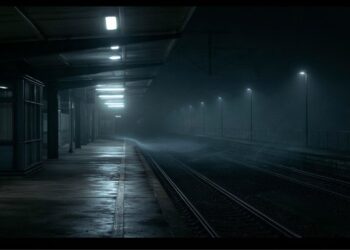
An abandoned station.
A room that appears to continue far beyond the walls around you.
The headphones have not transported you anywhere.
But they have changed which space dominates your attention.
Speakers Let the Real World Back In
Speakers create a different relationship.
Now the recording occupies the same physical environment as you do.
It reaches you through the room.
You can move closer.
Walk away.
Stand in another room.
Let a wall remove some frequencies.
Hear the track from a hallway.
That distance can sometimes make ambient music more convincing.
A sound designed to feel distant can actually become physically distant.
Play a drone quietly in the next room and it stops behaving like a conventional piece of music.
It becomes environmental.
Something that appears to be happening in the building.
This can produce a strange effect.
You stop actively listening.
Then you notice the music again several minutes later.
For a moment, you may not immediately remember where the sound came from.
That small confusion between recorded environment and real environment is something ambient music can exploit beautifully.
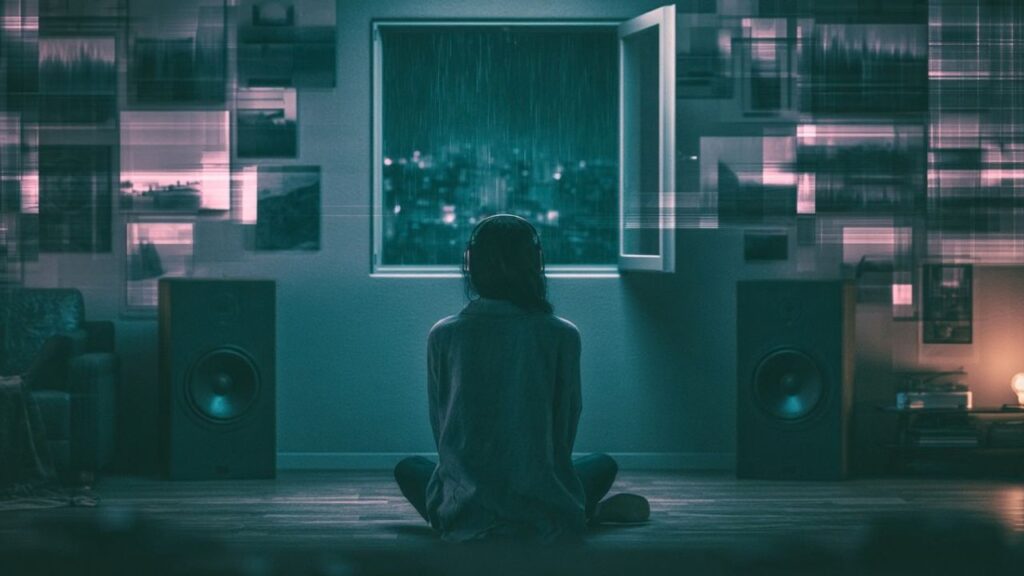
Why Music Feels Different at Night
Time changes listening too.
The same track can feel different at midnight than it does at midday.
Part of the reason is simple.
The world changes.
Traffic often decreases.
People become quieter.
Fewer doors open.
Fewer voices enter the room.
The background sound level drops.
That makes quieter elements easier to perceive.
Research into everyday listening environments has found that ambient noise influences the listening levels people choose. In noisier environments, listeners tend to increase playback levels. PubMed
At night you may not need to do that.
Quiet music can remain quiet.
And ambient music often benefits from that.
The lowest textures become available.
Small movements matter.
Silence begins to feel intentional.
This is one reason nighttime listening is not simply daytime listening with the lights turned off.
The environment has changed around the music.
Listening in Bed Changes the Scale
There is another kind of listening environment that rarely appears in discussions about sound quality.
The bed.
For many people, this is where ambient music becomes most personal.
You are physically still.
The room is dark.
There are fewer visual distractions.
Your attention is no longer divided between dozens of objects.
A track that felt like background music at a desk can suddenly feel enormous.
Not because the mix became larger.
Because your world became smaller.
There is something important in that.
Perceived scale is not only created by volume or reverb.
It is created by contrast.
When everything around you becomes quiet and still, a tiny sound can feel significant.
Walking Creates a Moving Soundtrack
Walking does the opposite.
Now the environment constantly changes.
A track might begin in a residential street.
Continue through a tunnel.
Pass beside traffic.
Move into a park.
Cross a station.
The recording stays fixed while the world around it changes every few seconds.
The result becomes a collaboration.
Research into headphone listening during commuting has specifically examined how music interacts with the surrounding multisensory environment and whether those two experiences feel matched or mismatched. CityUHK Scholars
You can experience this without thinking about the science.
Put on atmospheric music and walk through a city after dark.
The traffic lights suddenly seem connected to the rhythm.
A passing train becomes part of the composition.
Footsteps add percussion.
Rain adds texture.
Architecture becomes scenery.
The music begins editing reality.
This is why certain tracks become permanently attached to places in memory.
You may later hear the track at home and suddenly see that street again.
Sometimes the Environment Fits the Music
There are moments when the recording and the environment seem to agree.
Dark ambient in an empty station.
Warm ambient during rain.
A slow drone while watching fog move through a field.
Soft electronic music while travelling on a night train.
Nothing objectively says these combinations belong together.
But when they fit, the listening experience can feel almost cinematic.
The world begins behaving like the visual layer of the music.
That is one reason people often describe atmospheric music using places rather than technical characteristics.
Not:
The synth pad has a long reverb tail.
But:
It sounds like standing inside an empty airport at 3AM.
Place communicates emotion faster than production terminology.
Sometimes the Mismatch Is More Interesting
But perfect alignment is not always what makes listening memorable.
Sometimes contrast produces the stronger experience.
Dark ambient on a bright summer afternoon.
Soft ambient inside a crowded train.
A beautiful drone while walking through an ugly industrial area.
Peaceful music in an environment that feels chaotic.
The recording creates an alternative emotional layer over reality.
You experience both at once.
The world says one thing.
The music says another.
That tension can make familiar environments feel new.
A supermarket can become strangely cinematic.
A motorway becomes meditative.
An office building can briefly feel like a science-fiction set.
Music changes interpretation without changing the physical place itself.
Reverberant Spaces Can Make Ambient Feel Enormous
Some environments make this relationship especially obvious.
Churches.
Warehouses.
Tunnels.
Large halls.
Spaces with long reverberation do something that a small dry room cannot.
They extend sound physically.
A short musical event continues after the source stops.
That is one reason it is interesting to see contemporary ambient programming deliberately choosing distinctive listening environments.
MEZAME’s September 2026 New York programming, for example, placed ambient, electronic and experimental performances inside St. Bartholomew’s Church, whose large nave provides a highly distinctive acoustic environment. mezame.nyc
In London, Ambient Sauna events at Sauna Social Club have been using spaces equipped specifically for attentive listening, including sauna rooms and a listening lounge. Resident Advisor
These events point toward something larger.
Ambient music does not always need to be treated like ordinary concert music.
Sometimes designing where people listen is part of designing how they listen.
The Listening Space Can Become Part of the Composition
This connects directly to field recording.
When an artist records rain, stations, forests, traffic or room tone, a real environment enters the music.
But the process happens again during playback.
The recorded environment meets the listener’s environment.
Imagine a recording containing rain.
You play it while actual rain hits your window.
Now there are two rains.
One recorded.
One happening now.
Eventually it may become difficult to distinguish them.
Or imagine listening to railway field recordings while waiting for a real train.
The recording and reality begin overlapping.
In When the Real World Enters the Music, I explored why field recordings can make atmospheric music feel grounded in a real place.
The listening environment completes that idea.
The world enters the recording during production.
Then the world enters it again during listening.
Background Noise Is Not Always the Enemy
We have been trained to think good listening means eliminating everything else.
Sometimes that is useful.
But ambient music does not always need a perfectly silent environment.
A little background sound can make the experience more interesting.
Traffic.
Rain.
Fans.
Air conditioning.
Coffee-shop noise.
Wind.
A distant television.
These sounds create context.
The question is whether they destroy the music or interact with it.
If the ambient environment becomes too loud, details disappear and listeners tend to raise playback levels. Research measuring everyday music listening found clear differences in preferred volume across quieter and noisier environments.
But below that point, environmental sound can function almost like an uncontrolled remix.
Every listening session becomes slightly different.
You Do Not Need Better Equipment to Experiment With This
There is an easy trap here.
Once you start talking about rooms and playback systems, listening becomes another technology problem.
Better headphones.
Better speakers.
Acoustic treatment.
DACs.
Amplifiers.
Measurement.
Those things can matter.
But they are not required for the experiment I am describing.
Try something simpler.
Take one ambient track you know well.
Listen through headphones in darkness.
Play it quietly through speakers during the day.
Listen while walking.
Play it from another room.
Listen beside an open window during rain.
You will probably notice different parts of the recording each time.
Not because one version is necessarily better.
Because listening is contextual.
The Best Place to Listen May Depend on What You Need
There may not be one ideal ambient listening environment.
It depends on what you want from the music.
For focus, you may want predictability.
For sleep, you may want low volume and very little variation.
For emotional escape, headphones and darkness may create stronger immersion.
For reading, speakers may allow music to remain present without dominating attention.
For walking, the surrounding environment may become part of the experience.
For active listening, a quiet room may expose details you normally miss.
The important shift is to stop thinking of the listening environment as neutral.
It rarely is.
Music Is Becoming a Place We Visit
This connects to a larger idea I have explored before on DarkLofi.
Atmospheric music increasingly behaves less like a conventional song and more like a place.
You enter it.
Remain there.
Notice details.
Then leave.
If that is true, the room where you listen becomes the doorway.
A bedroom produces one version of the place.
Headphones create another.
A train creates another.
An empty church changes it again.
The recording provides the architecture.
Your environment provides the weather.
And your own state of mind determines what the place means when you arrive.
Listen to the Room Too
The next time you play ambient music, do not only listen to the track.
Listen around it.
What else can you hear?
How large does the room feel?
What disappears when the music starts?
What sounds begin blending into it?
Would the same recording feel different outside?
At night?
On a train?
In another room?
There is no correct environment.
That is the interesting part.
Every place produces a slightly different version of the same recording.
Because you were never listening to the recording alone.
You were listening to the world at the same time.
And sometimes the world is part of the music.
FAQ
Does ambient music sound different depending on where you listen?
Yes. Room acoustics, background noise, playback system, listening position and the surrounding environment can affect both the physical sound reaching you and your perception of it. Research has shown that different listening rooms can change perceived immersion and that ambient noise affects preferred listening volume. Aalto University’s research portal
Are headphones better for ambient music?
Not necessarily. Headphones can reveal small details and reduce the acoustic influence of the room, which can create a more private and immersive experience. Speakers allow the music to interact with the physical space and can produce a more environmental feeling. They offer different experiences rather than a simple better-or-worse choice.
Why does ambient music feel better at night?
Nighttime environments are often quieter and contain fewer competing stimuli. This can make subtle musical details easier to notice and allows atmospheric music to remain at lower playback levels without being masked by surrounding noise.
Is ambient music good for walking?
It can be. Walking creates a changing listening environment where traffic, architecture, weather and movement interact with the recording. Research into headphone listening during commuting suggests that surrounding multisensory context contributes to the listening experience. CityUHK Scholars
Does room acoustics matter for ambient music?
Yes. Reflections and reverberation change spatial perception. Research comparing listening environments has found that room characteristics can influence perceived immersion. Aalto University’s research portal
Why do field recordings work so well in ambient music?
Field recordings introduce recognizable environmental information into a composition. During playback, those recorded sounds can interact with the listener’s own environment, sometimes making the boundary between recorded space and physical space less obvious.