




















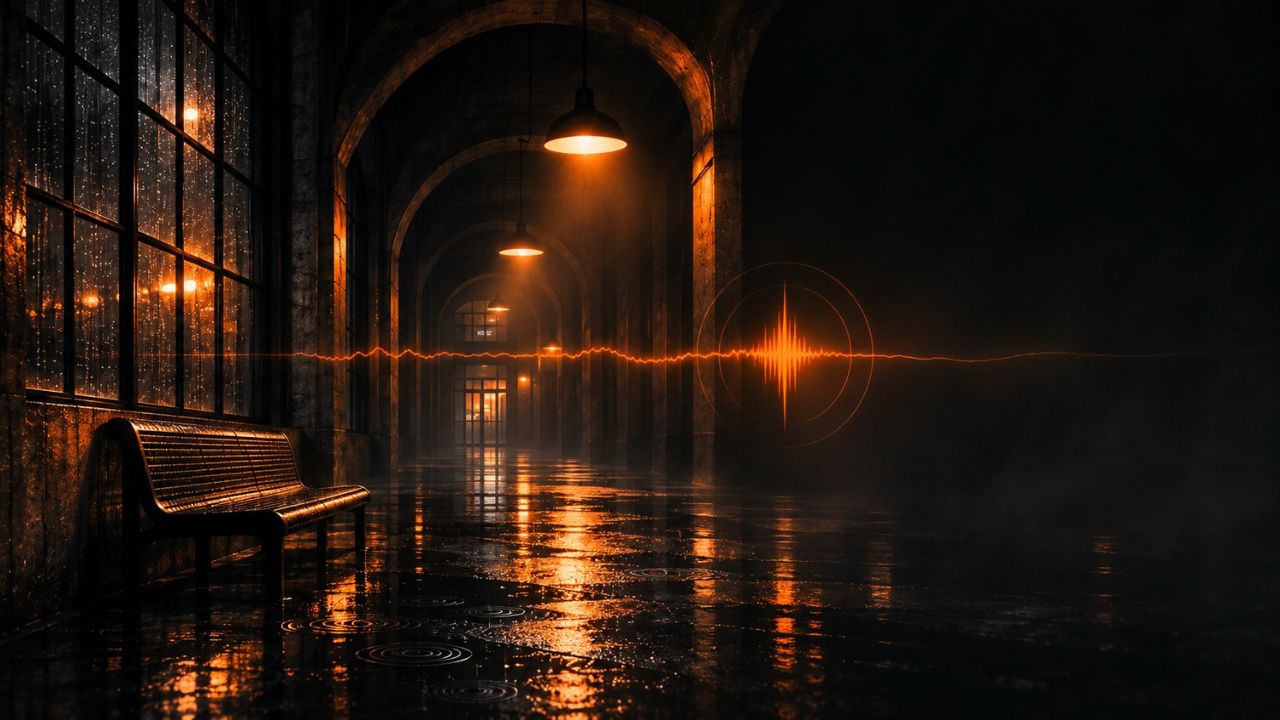
Silence is not empty.

In dark ambient music, it can be one of the most important sounds in the entire composition.
A low drone disappears. A distant texture remains for another few seconds. Reverb slowly dissolves into the room. Then there is almost nothing.
You wait.
And because you are waiting, you begin to listen differently.
This is the architecture of silence.
Dark ambient music often works not because of how much sound it contains, but because of how carefully that sound is surrounded by space. The pauses, gaps, fading reverberations and barely audible room tones create a framework around the music.
They give sound somewhere to exist.
And sometimes, what is missing becomes more powerful than what is present.
What is negative space in music?
Negative space is the area around the main musical elements where little or nothing happens.
In visual art, negative space is the empty area surrounding a subject.
Music can work in much the same way.
A melody becomes clearer when it is not surrounded by dozens of competing sounds. A single piano note can feel enormous when several seconds pass before the next one arrives. A distant mechanical noise can become unsettling when it appears inside an otherwise quiet soundscape.
Negative space creates contrast.
In dark ambient music, that contrast can be especially important because the music often depends less on conventional melody and rhythm and more on atmosphere, texture, distance and expectation.
Silence becomes part of the composition.
Not an interruption.
Not a mistake.
A structural element.
Why does silence make sound feel more powerful?
The human ear quickly adapts to continuous information.
When a sound remains constant for long enough, part of our attention begins to move elsewhere. But when something changes, disappears or returns unexpectedly, attention shifts back toward it.
Silence creates that change.
Imagine a deep drone playing continuously for five minutes.
Now imagine the same drone fading away after two minutes.
For several seconds, only a faint room tone remains.
Then the drone slowly returns.
The sound itself may not have changed very much. But your relationship with it has.
You notice it again.
The absence has given the sound new weight.
This is one reason dark ambient music can feel so immersive with relatively few elements. It does not always need more layers.
Sometimes it needs more distance between them.
Silence creates tension
A pause creates a question.
Will something happen?
Will the sound return?
Was that distant noise part of the music, or something outside the room?
Dark ambient composers can use this uncertainty deliberately.
A texture may disappear just before it feels resolved. A low-frequency rumble may emerge so gradually that you are unsure when you first noticed it. A metallic sound may echo once through a large imaginary space and never return.
Nothing dramatic needs to happen.
The expectation becomes the event.
This is especially effective in darker or more liminal music because the listener begins to mentally complete the space.
The music gives you enough information to imagine a place, but not enough to fully understand it.
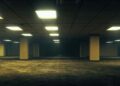
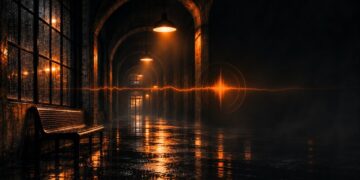
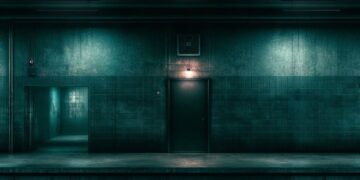
An empty corridor.
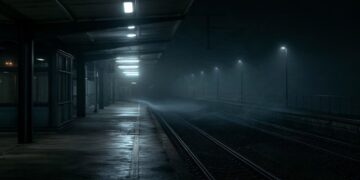
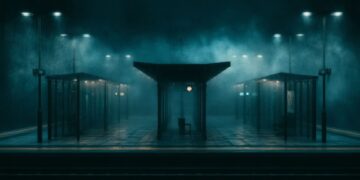
A station after midnight.
A room behind a locked door.
A distant machine still operating somewhere underground.
Silence gives the imagination room to enter.
Pauses and gaps change our sense of time
Dark ambient music often feels slower than its actual duration.
Part of this comes from the absence of strong rhythmic markers.
Without a conventional beat telling you exactly where you are, time becomes less defined.
Pauses deepen that effect.
A few seconds of near-silence can feel much longer when you are waiting for the next sound.
This creates breathing room inside the composition.
Not necessarily relaxation.
Sometimes the opposite.
A pause may create calm. It may also create anticipation, loneliness or unease.
Its emotional meaning depends on what came before it and what follows.
That is why silence works best when it is treated as part of the arrangement rather than simply as an empty section.
The gap has a purpose.
The reverb tail is where the room keeps speaking
Sound rarely stops immediately.
Especially in an imagined large space.
A note ends, but its reflections continue travelling through the environment.
This fading sound is the reverb tail.
In atmospheric music, the reverb tail can sometimes be more interesting than the original sound.
A piano note may last only a second.
Its ghost may remain for ten.
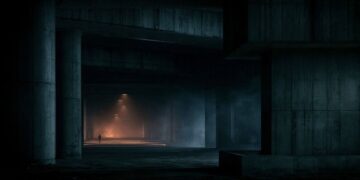
A metallic impact may disappear quickly while its reflections suggest a vast underground chamber.
A distant voice may become impossible to understand while still leaving an emotional trace behind.
The original sound tells you what happened.
The reverb tells you where it happened.
This is why decay time matters so much in dark ambient sound design.
Long reverberation can suggest enormous architecture.
Short reflections may create the impression of a small concrete room.
Dark, filtered reverb can make a space feel old or enclosed.
Bright reflections can make it feel colder and more exposed.
The room becomes part of the instrument.
“I don’t create silence because the music needs to be better. I create space because sometimes my mind needs it. What the listener finds in that space is entirely their own.”
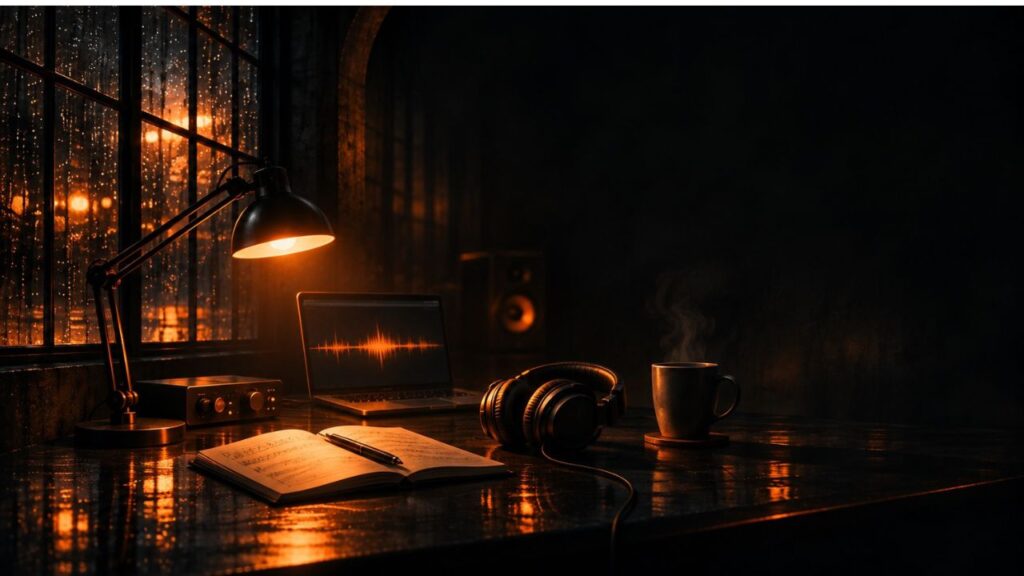
Room tone prevents silence from becoming completely empty
Absolute digital silence can feel unnatural.
Real spaces are rarely silent.
There is ventilation.
Electricity.
Distant traffic.
Wind against a window.
Heating systems.
Building resonance.
A faint electrical hum.
Sounds from somewhere you cannot quite locate.
This background ambience is often called room tone.
In dark ambient music, room tone can create continuity between larger musical events. Even when the obvious instruments disappear, something remains.
The space continues to exist.
This is particularly useful when creating liminal soundscapes.
Instead of moving between sound and nothing, the composition moves between different levels of presence.
A drone disappears.
The room remains.
A texture fades.
Rain continues somewhere outside.
A distant mechanical hum becomes noticeable only because everything else has stopped.
The silence is alive.
The listening effect: less information can create deeper attention
Modern listening environments are filled with information.
Notifications.
Voices.
Music competing with other music.
Videos playing while another screen remains open nearby.
Dark ambient music can move in the opposite direction.
It can remove information.
Fewer events.
Longer transitions.
Less obvious rhythm.
More space.
This does not automatically make the music relaxing. But it changes the way you listen.
When fewer things happen, smaller changes become significant.
A texture moving slightly from left to right matters.
A distant sound appearing once matters.
A low note slowly becoming brighter matters.
Attention becomes more sensitive.
You stop waiting for the next big event.
You begin noticing the room around the event.
Perhaps that is one reason this kind of music can accompany writing, reading, late-night reflection or quiet creative work so naturally.
It does not constantly demand attention.
It leaves somewhere for attention to rest.
Dark ambient music is often built by removing rather than adding
When a composition feels unfinished, the instinct is often to add something.
Another pad.
Another drone.
Another field recording.
Another layer of texture.
But adding sound does not always create depth.
Sometimes it removes it.
If every part of the frequency spectrum is occupied, nothing feels distant.
If sound is constantly present, nothing feels important when it arrives.
If every moment contains information, the listener has no room to imagine what lies beyond it.
Removing an element can therefore change a composition more dramatically than adding one.
Mute the pad.
Delay the next note.
Allow the reverb to disappear completely.
Let the room exist alone.
Then listen again.
You may discover that the track has become larger precisely because there is less inside it.
When My Mind Becomes Too Full
There is a moment during composing when I notice that my mind is becoming too full.
I have been listening, experimenting, adding layers and shaping sounds for a while. Slowly, everything begins to compete for my attention.
Not only inside the music, but inside my head.
That is usually when I know I need to create space.
Sometimes I remove an entire melody. Other times, I let the main pad or soundscape disappear, allowing it to return much later in the track.
And something changes.
I wouldn’t necessarily say the music sounds better. That is not really for me to decide.
But my mind becomes quieter.
And almost immediately, the music begins to feel different. As if the remaining sounds resonate more naturally with my body and my thoughts.
There is less to follow. Less to process.
More room to simply listen.
Perhaps that is what silence means to me as a composer. Not an absence of creativity, but a way of finding space within it.
Whether the result is better music is something I leave to the listener.
I can only hope that somewhere, in their own quiet moments, they experience a little of what I experience while creating it.
Sometimes I remove sounds not because the music needs less, but because my mind needs more space.
A simple signal flow for atmospheric music
One way to think about dark ambient composition is not as a collection of instruments, but as a movement through space.
Source → Sound → Space → Silence → Impact
The source might be a synthesizer, piano, field recording, processed voice or found object.
The sound is shaped through filtering, modulation, distortion or other processing.
Then comes the environment: reverb, reflection and distance.
After that comes something equally important.
Restraint.
The moment when the sound is allowed to disappear.
Only then can its return carry full weight.
This approach changes the question from:
What should I add next?
to:
What happens if I leave this moment alone?
That is often a more interesting question.

Six building blocks of silence
The architecture of a quiet composition can be understood through six connected ideas: pause, contrast, room tone, decay, breath and threshold.
A pause gives the listener time to notice what has disappeared.
Contrast makes a quiet sound feel larger by placing it beside something even quieter.
Room tone keeps the imaginary environment alive when the musical foreground disappears.
Decay allows a sound to gradually become part of its surroundings.
Breath introduces a natural rhythm of appearance, absence and return.
And the threshold is the point where sound becomes so quiet that you are no longer certain whether you are hearing it or imagining it.
That threshold is an interesting place to compose.
Dark ambient music often lives there.
Why negative space works so well with liminal spaces
There is a natural connection between dark ambient music and liminal imagery.
Both are concerned with what happens between defined states.
A corridor is neither the room you left nor the room you are entering.
A railway platform at night is a place designed for crowds that suddenly contains almost nobody.
An empty office building still carries traces of the people who normally occupy it.
These places feel strange because their usual function has temporarily disappeared.
Negative space in music creates something similar.
The expected structure is missing.
The beat does not arrive.
The melody remains unresolved.
The voice disappears before explaining itself.
Something should be here.
But it isn’t.
That absence becomes part of the atmosphere.
Music for writing after midnight
Silence can also have a practical function.
When music contains fewer sudden events, vocals or dominant melodic ideas, it may sit more easily beside creative work.
For writing, that can mean atmosphere without constantly competing with language.
A slowly changing soundscape can provide a sense of place while leaving enough mental space for your own thoughts.
The music becomes less like a performance in front of you and more like a room around you.
Perhaps a dimly lit one.
Music for reading
Reading creates its own internal soundtrack.
You imagine voices.
Rooms.
Weather.
Distance.
Movement.
Highly detailed music can sometimes compete with that inner world.
Sparse ambient music leaves more of the picture unfinished.
The book can fill it.
This is especially interesting with science fiction, psychological horror, speculative fiction and stories built around atmosphere.
The music suggests a world without defining it completely.
Music for overthinking nights
There are nights when silence itself feels too loud.
Thoughts become the foreground.
A completely silent room leaves nothing between you and them.
This is where very restrained ambient sound can occupy an unusual middle ground.
Not silence.
Not distraction.
Something quieter.
A low drone.
Rain against imaginary glass.
A distant tone slowly fading into darkness.
The sound does not need to solve anything.
It simply gives the night another layer.
Music for sleep transitions
The transition toward sleep is itself a threshold.
You are still aware of the room, but your thoughts begin losing their edges.
Sounds change meaning.
Distance becomes difficult to judge.
Small noises seem unusually important.
Ambient music designed with long decay, minimal harmonic movement and gentle negative space can mirror that transition.
Instead of pulling you toward the next musical event, it allows events to become less important.
Eventually, you may stop following the music altogether.
And perhaps that is exactly what the music was designed to allow.
Empty-space photography and sound
Photography taught me something similar.
An empty place is rarely truly empty.
Remove the people from a station, corridor or street and you begin noticing different things.
Light.
Reflections.
Architecture.
Distance.
Evidence that someone was there before you.
Sound behaves in much the same way.
When you remove enough musical information, the environment becomes visible through listening.
The reverb becomes architecture.
Room tone becomes weather.
A distant sound becomes a location.
Silence becomes composition.
Photography and ambient music meet at the same question:
What becomes visible when the obvious subject disappears?
How do you use silence when composing dark ambient music?
You do not necessarily need to begin with silence itself.
Begin with atmosphere.
Create the room.
Add one sound.
Listen to what happens after that sound disappears.
Then resist the instinct to immediately replace it.
Leave several seconds untouched.
Listen again.
The most important part of the composition may not be the note.
It may be the space that follows it.
That space determines how the next sound will feel.
Frequently asked questions about silence in ambient music
What is negative space in music?
Negative space is the intentional space around musical elements where little or no prominent sound occurs. It can include pauses, sparse arrangements, quiet room tone and long periods between musical events. In ambient music, negative space helps create contrast, atmosphere and a sense of depth.
Why is silence important in dark ambient music?
Silence allows individual sounds to carry more emotional weight. It can create tension, anticipation, distance and uncertainty while giving the listener room to imagine an environment beyond the audible elements.
Is silence actually part of a composition?
Yes. Silence can influence rhythm, pacing, tension and structure just as strongly as audible notes. When a composer intentionally decides when sound begins, fades and disappears, silence becomes part of the arrangement.
What is room tone in ambient music?
Room tone is the subtle background sound of an environment. It may include air movement, electrical hum, distant traffic, mechanical noise or other low-level ambience. It keeps a soundscape feeling alive even when the main musical elements disappear.
How does reverb create a sense of space?
Reverb simulates or captures reflections produced when sound interacts with an environment. The character and duration of those reflections can suggest the apparent size, material and distance of an imagined room or landscape.
Why does dark ambient music often use very few sounds?
Sparse arrangements allow individual textures, reverberations and environmental details to become more noticeable. Fewer elements can create a stronger sense of scale because the listener has more room to perceive and imagine the space between sounds.
The silence after the sound
When I think about dark ambient music, I increasingly think less about filling a track and more about constructing a place.
The sounds are only part of that place.
There are walls we never see.
Rooms beyond the room.
Distances suggested by echoes.
Thresholds that may never be crossed.
And between all of them is silence.
Not absolute silence.
Something closer to a listening space.
A place where a sound can appear, remain for a moment, and disappear again.
The silence gives it shape.
The absence gives it meaning.
And sometimes, when almost everything has faded away, you begin to hear the world behind the music.
Wartonno Sound explores the spaces between sound, memory, isolation and atmosphere. Music for overthinking nights, quiet focus, forgotten places and the moments when the world becomes a little less defined.