
























AI Is Moving Beyond the Screen – What It Means for Music, Creativity, and Dark Lofi
The future of AI may not be another chatbot. It may be an atmosphere.
Artificial intelligence is entering a new phase.

For the last few years, most people experienced AI through a screen: a chatbot window, a writing assistant, an image generator, a music tool, or a recommendation algorithm. But the latest AI news suggests something bigger is happening.
AI is becoming infrastructure.
It is moving into hardware, streaming platforms, open-model debates, data centers, creative tools, music distribution, and everyday listening habits. The most important AI question is no longer simply: Which model is the smartest?
The better question is:
Who can build the most meaningful experience around AI?
For music creators, especially independent artists working in dark ambient, cinematic ambient, lo-fi, cyberpunk, and worldbuilding, this shift matters.
Because if AI becomes something people live with instead of something they open, music will not just be background sound anymore.
It will become part of the interface.
OpenAI’s Screenless Device Points Toward Ambient AI
One of the most interesting recent AI stories is OpenAI’s reported work on a screenless consumer device with former Apple designer Jony Ive. Reports describe the device as screen-free, voice-driven, and designed as a new kind of AI-first companion or home computer rather than a traditional smartphone or app.
That matters because it suggests a broader direction for consumer AI.
AI may become less about typing into a box and more about interacting with your environment through voice, context, memory, and presence.
For musicians, this opens a fascinating possibility.
People may increasingly ask AI systems for music based on a moment rather than a genre:
“Play something for overthinking at 3AM.”
“Give me a soundscape for reading cyberpunk.”
“Create a quiet room for sleep.”
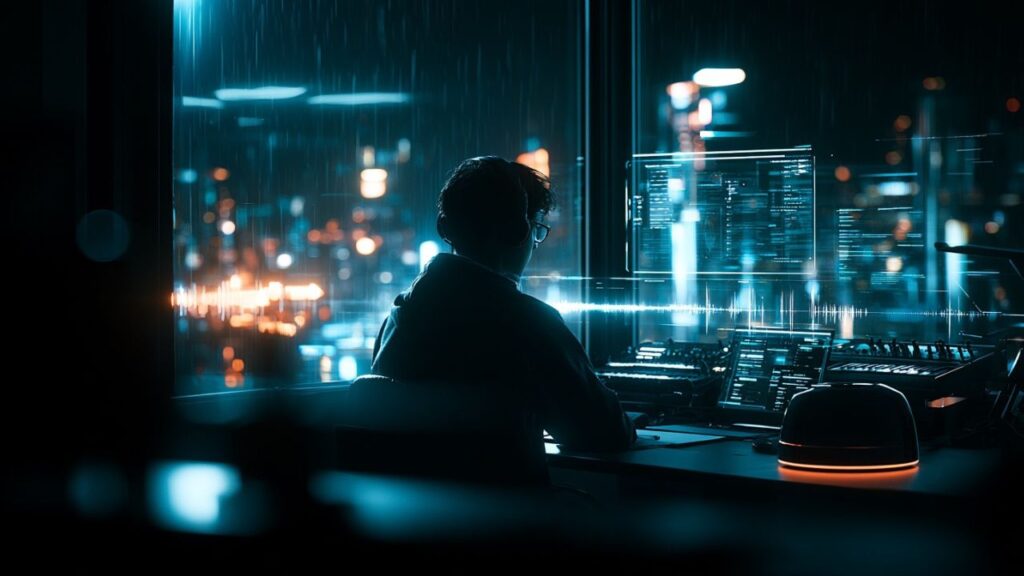
“Play music that feels like rain behind a window in a city that no longer exists.”
That is exactly where dark ambient and liminal music already live.
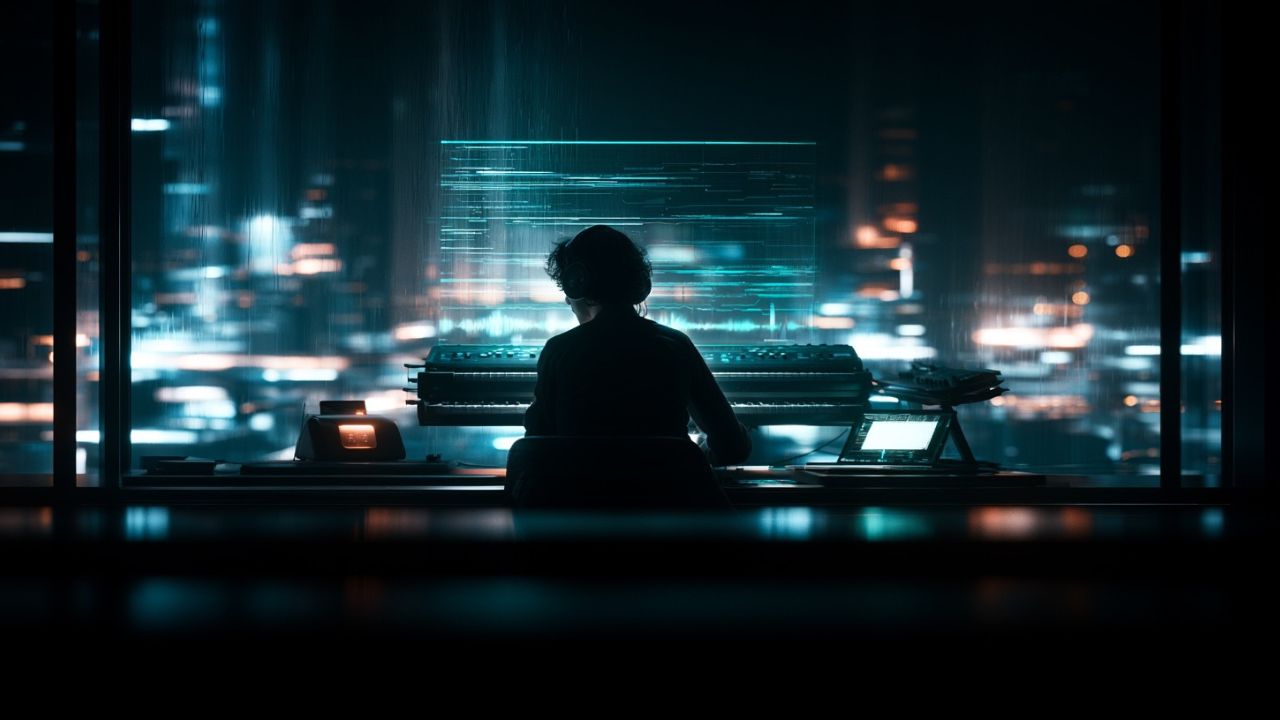
Dark lofi, cinematic ambient, and worldbuilding-based music are naturally contextual. They are not only about songs. They are about moods, scenes, rooms, rituals, and imaginary places.
AI Infrastructure Is Becoming the Real Battleground
Another major AI story is the enormous amount of money being poured into AI infrastructure.
Nvidia has reportedly been in talks around a massive financial backstop connected to an OpenAI data center project, raising investor concern about circular financing and whether parts of the AI economy are becoming too dependent on infrastructure spending.
At the same time, market leadership between companies like Apple and Nvidia has become closely tied to AI strategy. Reuters reported that Apple briefly overtook Nvidia in July 2026 as investors looked beyond the most obvious AI hardware winners, while later reports showed Nvidia reclaiming the top position after Apple stumbled.
The details will keep changing, but the direction is clear:
AI is not just a software trend anymore.
It is becoming a contest over chips, data centers, devices, energy, distribution, interfaces, and ecosystems.
For independent creators, that can sound distant. But it has a very practical meaning:
The tools will become cheaper, faster, and more available.
When everyone has access to powerful AI tools, the advantage will no longer be access. The advantage will be taste, identity, story, and direction.
AI Music Is Already Flooding Streaming Platforms
The music industry is already seeing what happens when generative tools become widely accessible.
Deezer reported that AI-generated tracks reached 90,000 uploads per day at peak levels in June 2026, representing more than 50% of all new daily music uploads on the platform. Deezer also says it began detecting, tagging, and excluding AI-generated music from algorithmic recommendations in 2025.
This is a huge signal.
AI music is no longer a novelty. It is becoming part of the supply chain of streaming platforms.
But more music does not automatically mean more meaning.
When platforms are flooded with generated tracks, listeners may begin to look harder for something with authorship, emotional identity, and a recognizable world behind it.
That is where human-led music projects still have a serious advantage.
TIDAL Draws a Line Around Fully AI-Generated Music
TIDAL has also taken a strong position. The platform says music that is 100% AI-generated will not be monetized, will not receive royalties, and will not be eligible for direct-to-fan sales. TIDAL also says it will not tolerate AI-generated music that impersonates artists or contributes to fraud.
This is one of the most important developments for independent musicians.
It suggests that platforms may increasingly distinguish between:
AI-generated music
Music created mostly or entirely by automated systems.
AI-assisted music
Music where AI tools support a human-led creative process.
That distinction is crucial.
DarkLofi.com, Wartonno Sound, Meridian City, Aely Lin, and SOMNII sit much closer to the second category: AI as a tool inside a larger creative ecosystem.
The value is not only the audio file.
The value is the world around it.
Why Worldbuilding Becomes More Valuable in the AI Era
When anyone can generate a track, the question becomes:
Why should anyone remember yours?
This is where worldbuilding becomes a creative advantage.
A Wartonno Sound track can be more than dark ambient music. It can be a room, a corridor, a signal, a lost tape, or a fictional archive.
Aely Lin can be more than an AI-assisted vocal project. She can belong to Meridian City, with characters, fragments, visual identity, stories, and emotional continuity.
SOMNII can be more than bedroom pop. It can represent insomnia, memory, late-night emotion, and dreamlike electronic storytelling.
That is much harder to replace than a generic generated track.
But a creator builds continuity.
The Real Future of AI Music Is Human Direction
A recent research paper on AI music streaming examined the rise of “AI slop”: mass-produced, low-effort music uploaded to platforms in large volumes, often with little engagement and inconsistent policy enforcement across distributors. The paper found that most AI music in its sample received little or no listener activity, while many AI creators released large volumes of tracks across multiple genres in the hope that something would work.
That is not the future worth building.
The stronger path is human direction.
For independent musicians, the question should not be:
“How many tracks can I generate?”
The better questions are:
“What world does this music belong to?”
“What emotion does this track protect?”
“What story does it continue?”
“What listener moment does it serve?”
That is the difference between disposable output and meaningful creative work.
What This Means for Dark Ambient and Liminal Music
Dark ambient music is well positioned for the next phase of AI.
Why?
Because dark ambient is already experiential. It often works best when attached to a context:
- music for sleep
- music for reading
- music for studying
- music for overthinking
- music for liminal spaces
- music for cyberpunk worlds
- music for fictional archives
- music for emotional reset
- music for late-night solitude
These are not just genres. They are use cases. They are listener intentions.
As AI assistants become better at understanding context, music that is clearly connected to moods, rituals, stories, and scenes may become easier to recommend.
That makes titles, blog posts, playlists, captions, and worldbuilding more important than ever.
A track called Overthinking at 3AM communicates an emotional use case instantly.
A project like The Quiet Archive gives listeners a fictional container.
A world like Meridian City gives music a place to live.
Dark Lofi’s Position
Dark Lofi is built around one idea:
Music should feel like somewhere you can enter.
AI may help with parts of the creative process, but it does not replace the vision. The direction remains human. The final choices remain human. The atmosphere, story, and emotional intention remain human.
As AI becomes more powerful, creators do not need to compete by generating more content.
They need to create clearer worlds.
The future of AI music will not belong only to the fastest prompt writers.
It will belong to the artists who can build identity, atmosphere, and emotional trust around their sound.
Not more tracks.
More meaning.
Not more noise.
More worlds.
FAQ
What is AI-assisted music?
AI-assisted music is music where AI tools support the creative process, but the human creator remains responsible for the concept, direction, editing, arrangement, emotional tone, and final artistic identity.
How is AI-assisted music different from AI-generated music?
AI-generated music is often created mostly or entirely by automated systems. AI-assisted music uses AI as one tool inside a human-led workflow. The difference is authorship, intention, editing, and creative direction.
Why does AI matter for independent musicians?
AI tools make music creation faster and more accessible. But they also increase competition and content volume. Independent musicians can stand out by building strong identities, original stories, recognizable worlds, and clear listener use cases.
Why is dark ambient music well suited to AI-era discovery?
Dark ambient music is often tied to mood, atmosphere, and context. People search for music for sleep, focus, reading, anxiety, overthinking, liminal spaces, and cyberpunk worlds. These intent-based searches fit well with AI-powered discovery systems.
How does Dark Lofi use AI?
Dark Lofi treats AI as a creative tool, not as a replacement for human direction. The focus remains on dark ambient music, cinematic atmosphere, fictional archives, worldbuilding, emotional storytelling, and artist identities such as Wartonno, Meridian City, Aely Lin, and SOMNII.