


























There is a particular kind of creative frustration that does not come from having no ideas.
It comes from having too many.
You may want to write a book, release music, take photographs, build a website, start a newsletter, create videos, design products, or return to an old project that never entirely left you.
Every direction feels genuine.
Every project seems to contain part of who you are.
The problem is not beginning.
The problem is giving anything enough uninterrupted attention to become finished.
That is something I began to understand more clearly after turning 50.
I have never found starting especially difficult. A new project often arrives with energy. It opens a door. It teaches me a skill, introduces me to a platform, or gives me a new way to express something that has been waiting inside me.
But starting and finishing are not the same creative act.
Starting is possibility.
Finishing is commitment.
And when you are interested in many things, commitment can feel like closing all the other doors.
The problem is not a lack of ambition
One of my larger unfinished projects is built around Spotify.
The idea is to create and release a substantial collection of EPs under Wartonno Sound, building a deeper catalogue that can attract more listeners and generate consistent Spotify streams over time.
I expected the project to be finished in the first quarter of this year.
It is now only halfway complete.
The reason is not that I stopped caring about it.
The reason is that many other projects also matter to me.
Writing matters.
SoundCloud matters.
Blogging matters.
Visual creation matters.
Publishing matters.
New music ideas continue to appear.
When all of those interests share the same limited creative hours, progress becomes scattered. The Spotify project may receive an hour one week, then nothing for several weeks because another idea has moved to the front.
Technically, the project is still active.
In practice, it has lost momentum.
That distinction matters.
A project does not need to be abandoned to become stalled. It only needs to receive too little attention for too long.
Splitting attention feels productive – until it does not
When a new idea appears, I usually do not completely abandon the old project.
I split my attention.
At first, that can feel responsible.
You tell yourself that you are keeping everything moving. You spend a little time on music, a little time on writing, a little time on promotion, and perhaps another hour exploring a new concept.
Nothing has been forgotten.
But nothing receives enough depth either.
When five or ten projects share the same small pool of time, each may receive only an hour a week—or sometimes an hour a month.
That is rarely enough to maintain creative momentum.
Every time you return, you must remember where you stopped.
You reopen files.
You reread notes.
You reconstruct decisions.
You try to recover the emotional state in which the project originally made sense.
Part of the available hour is spent simply returning to the room.
Then, just as you begin to work, it is time to leave again.
This creates a pattern of repeated re-entry without meaningful completion.
You remain busy.
You may even learn a great deal.
But the finished work does not accumulate at the same rate as the ideas.
Curiosity is not the enemy
It would be easy to say that the solution is to stop exploring new things.
I do not believe that.
Curiosity has given me much of what I now use creatively.
Music production, independent publishing, photography, websites, artificial intelligence, social media, design, and storytelling all became available because I was willing to begin without knowing exactly where each path would lead.
Starting projects teaches you.
Even unfinished work can leave behind:
- technical knowledge;
- stronger creative taste;
- useful systems;
- better tools;
- new connections;
- fragments that later belong somewhere else;
- a clearer sense of what you actually want to make.
Not every unfinished project is wasted time.
Sometimes a project exists to teach you something rather than become a permanent part of your work.
But there is a difference between exploration and avoidance.
Exploration helps you discover a direction.
Avoidance keeps you changing direction whenever the work becomes slower, more repetitive, or more difficult to complete.
The difficult question is not whether a new idea is good.
It is whether it deserves your attention now.
When a new idea becomes Resistance
Steven Pressfield uses the word Resistance for the force that appears between the creator and the work that matters.
Resistance is often imagined as fear, procrastination, self-doubt, or laziness.
But for a multi-passionate creator, Resistance can look far more attractive.
It can arrive as a brilliant new project.
It can feel productive.
It can give you the excitement that has disappeared from the middle of the project already underway.
The new project offers:
- a clean beginning;
- no difficult decisions yet;
- no accumulated imperfections;
- no need to finish;
- no audience response;
- no possibility of visible failure.
The existing project asks for something different.
It asks you to edit.
To repeat.
To make choices.
To remove things.
To accept limitations.
To declare the work finished even though it could always be improved.
A new beginning protects potential.
A finished project exposes reality.
That may be why so many creative people have full notebooks, unfinished albums, abandoned manuscripts, half-built websites, and folders of ideas that still feel promising years later.
The ideas are alive because they have never had to become final.
Many interests are not the real problem
I do not think a person must reduce their identity to one creative discipline.
You can be a musician and a writer.
You can take photographs and publish books.
You can make music while building a visual world around it.
You can create in different forms because those forms may all come from the same underlying themes.
In my own work, music, writing, visual atmosphere, liminal spaces, late-night thought, and storytelling are not entirely separate.
They often feed one another.
The problem begins when every expression becomes an independent priority.
A person can have many interests.
A week cannot have unlimited priorities.
That is where focus becomes necessary.
Not as a rejection of curiosity, but as a temporary hierarchy.
You do not need one passion forever
The usual advice is to pick one thing and remain with it.
For some people, that works.
For others, it creates the feeling that they must amputate meaningful parts of themselves in order to become productive.
A calmer approach may be:
You do not need to choose one passion for the rest of your life. You need to choose one primary project for this season.
A season can be a month, a quarter, or the time needed to complete a clearly defined body of work.
During that season, other interests do not disappear.
They move into supporting or waiting positions.
This is not permanent.
That is what makes the decision easier.
You are not saying:
I will never write again because music is now my focus.
You are saying:
For this period, the music project receives my clearest time and best energy. Writing ideas will be preserved, but they will not become competing projects.
That is a boundary rather than a burial.
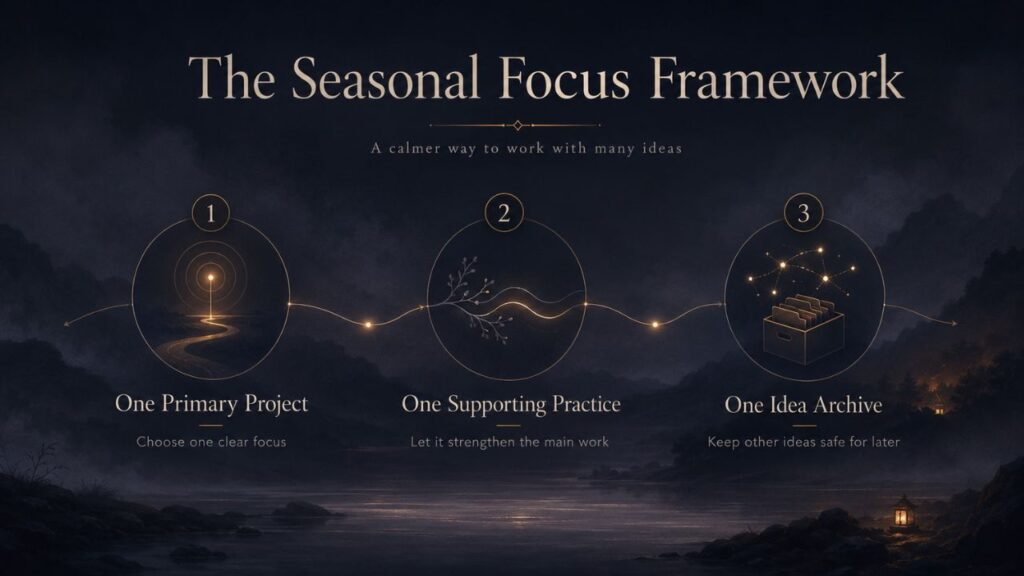
The Seasonal Focus Framework
I am beginning to think of creative focus in three layers.
1. One primary project
This is the project that receives the majority of your available creative energy.
It should have a visible end.
Not:
Work on Spotify.
But:
Complete and release the remaining EPs in the current Wartonno Sound catalogue project.
Not:
Write more.
But:
Finish the first draft of one novella.
Not:
Grow SoundCloud.
But:
Publish a consistent sequence of tracks and promotional posts designed to move toward 1,000 followers.
The primary project needs a definition of completion. Otherwise, it expands indefinitely and never creates the satisfaction of crossing a threshold.
2. One supporting practice
The supporting practice can continue, but it must strengthen rather than compete with the primary project.
For a music-release season, the supporting practice might be:
- one blog article connected to each release;
- one weekly SoundCloud upload;
- short visual content made from existing artwork;
- one newsletter note pointing listeners toward the music.
The supporting practice should reuse the energy of the main project.
It should not create a second full production system.
3. One archive for every other idea
New ideas need somewhere to go.
Without an archive, there are only two options:
- begin the idea immediately;
- fear that it will be forgotten.
A simple idea archive creates a third option:
This matters, but it does not need to become active today.
The archive can contain:
- a title;
- a short description;
- why the idea matters;
- the first possible action;
- the season in which it may be reconsidered.
This gives curiosity a safe room without allowing it to take over the entire house.
The difference between a goal and a project
My current ambitions include two clear audience goals:
- reaching 1,000 followers on SoundCloud;
- building more than 1,000 real fans around Wartonno Sound on Spotify.
These goals provide direction, but they are not projects by themselves.
That distinction is important.
You cannot directly complete “get 1,000 followers” in the way you can complete an EP, a track, an article, or a release campaign.
Follower and listener growth depends partly on other people.
A creative project should be something you can execute.
For example:
Goal
Reach 1,000 SoundCloud followers.
Executable project
Release one focused SoundCloud series with a fixed number of tracks, consistent covers, optimized descriptions, regular reposting, and a clear call to follow the profile.
Goal
Build 1,000 genuine Wartonno Sound fans on Spotify.
Executable project
Complete the planned EP catalogue, connect releases through playlists and related content, and build a repeatable system that sends interested listeners back to the artist profile.
The audience goal tells you where you want to go.
The project tells you what to do next.
Without that translation, growth goals can become emotionally heavy but practically vague.
Focus does not mean doing only one task
A music project naturally contains many tasks:
- composing;
- producing;
- mixing;
- mastering;
- artwork;
- distribution;
- metadata;
- blog content;
- short-form promotion;
- playlist organization;
- audience follow-up.
This may look like multitasking, but it can still be focused when every task serves the same outcome.
The real danger is not variety.
It is fragmentation.
Creating artwork for the EP is part of the project.
Starting an unrelated printable product because the artwork inspired a new business idea is fragmentation.
Writing a blog article that deepens the concept behind the music is part of the project.
Beginning a new fiction series before the music catalogue is complete may be fragmentation.
The difference is not always obvious.
A useful question is:
Does this activity move the current primary project closer to completion, or does it open another unfinished loop?
That question can remove much of the confusion.
Finishing requires a smaller definition
Large creative ambitions often remain unfinished because completion has been defined too broadly.
“Build a successful Spotify catalogue” is not one project.
It may include:
- finishing one EP;
- releasing the EP;
- creating a playlist;
- publishing supporting content;
- reviewing listener data;
- refining the next release.
Each completed unit creates momentum.
Without smaller endings, the entire ambition feels perpetually incomplete.
That can make even significant progress feel like failure.
My own Spotify project is halfway finished.
That is not nothing.
The mistake would be treating the unfinished half as one enormous fog-covered distance.
A better approach is to identify the next visible marker.
One EP.
One release date.
One campaign.
Then the next.
Focus often returns when the horizon becomes closer.

What better focus would look like for me
Better focus does not mean abandoning writing, photography, blogging, or new ideas.
It means allowing my current music goals to become concrete enough to guide weekly decisions.
The larger direction is clear:
- grow the SoundCloud profile toward 1,000 followers;
- build a community of more than 1,000 real fans around Wartonno Sound on Spotify;
- complete more of the EP catalogue that was originally meant to be finished earlier this year.
The practical question is no longer:
Which of my interests is the real one?
The practical question is:
Which completed body of work would create the most meaningful momentum now?
For this season, the answer may be music.
That does not erase the writer.
It does not erase photography.
It does not close the other rooms.
It simply leaves one light on more brightly than the others.
A simple focus exercise
You may find it useful to write down every active creative project.
Then place each project into one of three categories:
Primary
The one project that receives your strongest attention until a defined milestone is finished.
Supporting
A smaller practice that directly strengthens the primary project.
Parked
Projects and ideas that remain valuable but will not receive active production time during this season.
Then answer four questions:
- What does “finished” mean for the primary project?
- What is the next visible deliverable?
- Which weekly actions move it forward?
- Which appealing distractions are most likely to interrupt it?
The final question matters.
Focus is not only deciding what to do.
It is recognizing what you will temporarily decline.
The unfinished work is still waiting
There is no shame in having many interests.
There is also no shame in discovering that a project took longer than expected.
Creative life does not move in a perfectly straight line.
We return.
We change.
We learn new tools.
We reopen older ambitions.
We sometimes mistake motion for progress.
But eventually, the work asks for a decision.
Not a decision about who you will be forever.
Only a decision about what receives your attention now.
Perhaps focus is not a narrow corridor after all.
Perhaps it is a quiet agreement with yourself:
For this season, I will give one meaningful project enough time to become real.
The other ideas can wait nearby.
They do not need to disappear.
But this one deserves the chance to be finished.
Closing
Continue with The Second Creative Life
This article is part of The Second Creative Life, a Dark Lofi series about creative Resistance, renewed focus, meaningful work, and beginning again after 50.
Read the hub page:
The Second Creative Life: Creativity, Resistance and Finding Focus After 50
FAQ Section
Why do creative people have so many unfinished projects?
Creative people often enjoy the possibility and discovery found at the beginning of a project. Finishing requires repetition, limitation, editing, and exposure to judgment. New ideas can therefore become a more attractive alternative to completing difficult work.
How can I focus when I have many creative interests?
Choose one primary project for a defined period rather than choosing one passion forever. Keep one supporting practice and store all other ideas in an archive until the current milestone is complete.
Is being multi-passionate a weakness?
No. Multiple interests can provide depth, originality, and transferable skills. The problem occurs when every interest becomes an equal priority and none receives enough consistent attention to develop.
How long should a creative focus season last?
A focus season can last one month, one quarter, or until a specific deliverable is complete. The end should be defined by a visible outcome such as publishing a book, releasing an EP, or completing a photography series.
How do I finish more creative projects after 50?
Reduce the size of the next milestone, define what finished means, protect regular work sessions, and avoid activating unrelated projects until the current deliverable is complete.
Can I grow an audience while focusing on creative work?
Yes, but audience-building tasks should support the primary project. Reuse the same themes, artwork, stories, and release material across your blog, social channels, newsletters, SoundCloud, and Spotify rather than creating separate content systems for each platform.