












Dark ambient has traditionally known how to create emotion without saying a word.

A low drone.
A distant machine.
Reversed strings.
Tape hiss.
A piano somewhere at the end of a corridor.
Then something happens.
A voice appears.
But it does not always behave like a traditional vocal.
It may whisper.
It may repeat one sentence.
It may be stretched until the words disappear.
It may sound human for a moment and artificial the next.
And increasingly, that voice is becoming part of the atmosphere itself.
Welcome to one of the more interesting developments happening around dark ambient music in 2026.
Can Dark Ambient Have Vocals?
Yes.
Dark ambient can contain vocals without becoming conventional vocal music.
The important distinction is how the voice is used.
In a traditional song, the vocal usually leads. You listen to the singer, follow the lyrics and wait for verses and choruses.
In vocal ambient music, the hierarchy can reverse.
The voice becomes:
- a texture
- a distant presence
- a memory
- an environmental sound
- a narrative fragment
- another layer inside the soundscape
You may hear a person without feeling that someone is performing at you.
That difference matters.
Dark ambient has always been particularly good at suggesting unseen things. Adding a human voice gives that unseen world a presence.
Suddenly, the empty room may not be empty.
The Voice Is Becoming Part of the Soundscape
A useful current example is Venus Ex Machina‘s “Jericho.”
The track marks her first solo release since 2022 and introduces processed vocals into a sound already associated with dark ambient and post-industrial electronic music.
The vocals have been manipulated into something resembling machine-generated Gregorian chanting. The track follows an insomniac haunted by lost love during a long night.
That combination is interesting.
You have something recognizably human.
A voice.
But technology destabilizes it.
Is it a person?
A memory?
A machine trying to imitate a person?
That ambiguity is extremely compatible with dark ambient.
The voice does not destroy the atmosphere.
It deepens it.
Why Vocals Work So Well in Dark Ambient
Dark ambient creates space exceptionally well.
What it sometimes deliberately removes is human proximity.
That is part of its appeal. You can disappear into an environment without having somebody explain what you are supposed to feel.
But one quiet voice changes the emotional geometry of that environment.
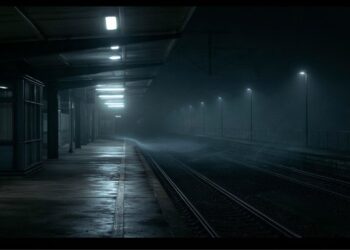
Imagine a huge abandoned station.
Without a voice, you experience the station.
Add a distant whisper and you immediately start wondering:
Who else is there?
This is why even tiny vocal fragments can dramatically change atmospheric music.
A voice suggests consciousness.
Consciousness suggests history.
History suggests a story.
And suddenly a soundscape becomes a world.
Dark Ambient Is Becoming Emotional World-Building
This connects with a larger development we have been following on DarkLofi.
Modern ambient music increasingly works as emotional world-building.
Rather than simply asking:
What melody should this track have?
An ambient composer can ask:
Where is the listener?
Perhaps you hear rain outside an apartment.
Perhaps you are inside an abandoned hospital.
Perhaps something is transmitting from a dead network.
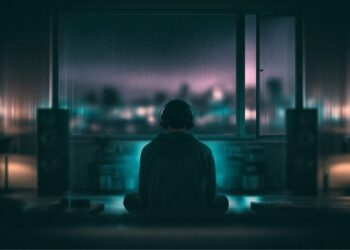
Perhaps you are sitting alone in a city at 3AM.
The voice can then become another piece of the environment.
Not necessarily the narrator.
Perhaps simply evidence that someone once existed there.
That approach brings music surprisingly close to cinema, games and fiction.
That connection between music, visual atmosphere and fictional worlds is also central to my work as Wartonno.
Sound does not have to explain the world.
It can imply it.
Ambient Music Is Also Becoming More Physical
This is not happening only through vocals.
Recent experimental ambient releases show a wider move toward music built from tactile, imperfect materials.
Swedish artist Klara Lewis, for example, builds Opening around ambient noise, processed samples, reversed strings, distortion and acoustic source material.
The Guardian described Lewis as a “sound sculptor,” an appropriate description for music where sounds feel shaped into an environment rather than arranged around a conventional song structure.
That idea helps explain why the human voice fits.
A voice can be sculpted too.
It can be slowed.
Cut.
Reversed.
Duplicated.
Filtered.
Buried beneath noise.
Placed far away.
Reduced to breath.
Once you stop treating vocals exclusively as carriers of lyrics, the human voice becomes one of the richest sound-design materials available.
There Is a Space Between Instrumental Ambient and Vocal Music
This may also solve a very practical listening problem.
Sometimes instrumental ambient feels too distant.
But conventional vocal music feels too demanding.
You want some human presence without having a singer constantly occupying your attention.
This middle space can offer exactly that.
Think of it as a spectrum:
Pure ambient → vocal textures → fragmented lyrics → intimate songs
There does not need to be a hard border between them.
This is where dark ambient can begin touching:
- dream pop
- bedroom pop
- slowcore
- post-industrial music
- experimental pop
- cinematic electronic music
- drone
- ambient pop
And that overlap is becoming more interesting than the genre boundaries themselves.
Bedroom Pop Approaches the Same Space From the Other Direction
Bedroom pop begins with something almost opposite to dark ambient.
The human voice is often the center.
Its power traditionally comes from closeness.
You hear the person.
Small details matter.
Breathing matters.
Imperfection matters.
The recording may feel less like somebody standing on a stage and more like somebody sitting across the room.
But bedroom pop is becoming increasingly atmospheric.
Voices sit deeper inside reverb.
Synths become more cinematic.
Dream pop, ambient, slowcore and experimental electronic production move into the same space.
So something fascinating happens.
Dark ambient moves toward the voice.
Bedroom pop moves toward atmosphere.
They meet somewhere in between.
Dark ambient offers space.
Bedroom pop offers proximity.
Combine them and you get something that can feel both enormous and intensely private.
Andy Stott Shows How Far This Can Go
Another interesting example arrives later this year.
British electronic producer Andy Stott will release Late Loop on October 30 through Modern Love.
The album represents a shift toward more song-focused structures and features vocalists Alison Skidmore and Elaine Howley throughout its eight tracks.
At the same time, Stott deliberately restricted his production environment, including working without basslines or reverb and with a limited effects setup.
This is significant because it demonstrates that experimentation does not necessarily mean adding more complexity.
Sometimes restriction creates intimacy.
Sometimes a voice creates the emotional scale that another synthesizer cannot.
And sometimes the most interesting electronic music happens when the distinction between song and soundscape starts disappearing.
Why the Human Voice Feels Different at Night
There is another reason this matters specifically for DarkLofi.
Night changes listening.
During the day, music competes with traffic, conversations, work and movement.
At night, small sounds become larger.
A quiet vocal recorded close to the microphone can feel almost unnaturally present through headphones.
A distant voice can feel even stranger.
This makes vocal ambient particularly effective for:
- late-night listening
- reading
- writing
- solitary walks
- creative work
- reflection
- overthinking
- cinematic immersion
Sometimes you do not want someone shouting the answer.
You simply want evidence that another human being exists somewhere inside the darkness.
From Singer to Ghost
Perhaps the biggest shift is conceptual.
In traditional music, the voice tells us:
Here I am. Listen to me.
In dark ambient, the voice can ask:
Was someone here?
That is a completely different relationship.
The singer becomes a trace.
A recording left behind.
A corrupted message.
A memory.
A transmission.
A ghost.
This idea also sits close to the liminal and dark ambient worlds I explore through Wartonno Sound.
And this is why human voices fit so naturally into liminal and dark ambient environments.
Liminal spaces already feel suspended between presence and absence.
Introduce a fragmented voice and that ambiguity becomes stronger.
You create a strange contradiction.
The environment is empty.
Yet somebody is there.
AI Makes the Human Voice Even More Interesting
There is also a new layer entering this discussion.
AI-generated and heavily processed voices make the boundary between human and synthetic sound increasingly difficult to recognize.
That makes an old question suddenly relevant to ambient music:
What makes a voice feel human?
Is it perfect pronunciation?
Probably not.
Perhaps it is breath.
Imperfection.
Timing.
Vulnerability.
Distance.
A crack.
A pause.
Dark ambient is unusually well suited to exploring this because uncertainty already belongs to the genre.
A voice does not need to be clearly human or machine.
The uncomfortable space between those two possibilities may actually be the most interesting territory.
The Future May Be Voice Without Vocal Music
This does not mean dark ambient is suddenly going to become full of singers.
Nor should it.
Silence and absence remain essential parts of the genre.
The interesting development is subtler.
Artists now have another tool.
A human voice can appear for ten seconds inside a ten-minute composition and completely change its meaning.
One whispered sentence can create more narrative than dozens of additional instrumental layers.
That makes the voice particularly powerful for artists working with ambient music as world-building.
You do not need a protagonist.
You only need a trace of one.
Final Thought
Dark ambient has always been good at creating empty places.
Now some of those places are beginning to speak.
Sometimes through whispers.
Sometimes through distorted singing.
Sometimes through voices that seem caught between human and machine.
And sometimes through one fragment that disappears before you understand what it meant.
That does not make dark ambient less mysterious.
It may make it more mysterious.
Because once you put a human voice inside an empty world, the listener starts asking the most important question:
Who was there?
And suddenly the background becomes a story.
Why are human voices appearing in dark ambient music?
Human voices are increasingly used in dark ambient as texture, atmosphere and narrative rather than traditional lead vocals. Whispers, processed singing, fragmented speech and heavily manipulated voices can introduce human presence without breaking the immersive nature of an ambient soundscape. This also creates overlap between dark ambient, ambient pop, bedroom pop, dream pop and experimental electronic music.
FAQ Section
Does dark ambient music have vocals?
Yes. Although much dark ambient is instrumental, vocals can appear as whispers, chants, spoken fragments, processed singing or atmospheric textures. Unlike conventional pop vocals, they often become part of the environment rather than the focal point.
What is vocal ambient music?
Vocal ambient music combines ambient soundscapes with the human voice. Vocals may contain conventional lyrics, but they can also be stretched, sampled, looped, filtered or used primarily for texture.
Why are processed vocals used in ambient music?
Processed vocals let producers preserve human emotion while making the voice feel distant, dreamlike, artificial or unfamiliar. This makes them particularly effective in dark ambient, cinematic ambient and experimental electronic music.
Is dark ambient similar to bedroom pop?
They are different genres, but they increasingly overlap. Dark ambient tends to emphasize space and texture, while bedroom pop tends to emphasize intimacy and vocals. Modern artists can combine both qualities in atmospheric, emotionally close music.
Is dark ambient good for late-night listening?
Many listeners use dark ambient for nighttime listening because its slow structures and immersive textures do not require the constant attention of conventional songs. Personal preference matters, especially because darker soundscapes can range from calming to deliberately unsettling.

















Comments 1