




















There is something strange about becoming a beginner later in life.
By the time you pass 50, you have probably spent decades learning how to function in the world. You know how to work, solve problems, talk to people, make decisions, take responsibility, and deal with things going wrong. In certain areas, other people may even come to you because they expect you to know what you are doing.
Then you start something new.
Suddenly, that comfortable sense of competence disappears.
You open unfamiliar software and cannot find a simple setting. You try a new photography technique and wonder whether the client will notice that you are still figuring it out. You record something and hear uncertainty in your own voice. You publish a piece of writing and wonder whether the reader will immediately recognize all the things you still do not know.
You may have fifty years of life experience behind you, but in this particular room, you are new.
I have felt that every time I have started again.
And perhaps that is exactly why beginning again can be so valuable.
The uncomfortable gap between experience and ability
When I returned to photography, returned to music, and eventually began writing and publishing, I did not suddenly feel like an experienced creator simply because I was older.
I felt like a beginner.
The uncomfortable part was not only learning the tools. It was the possibility that somebody else might notice that I was learning.
With photography, there is a client waiting for the result. They do not necessarily care that you are exploring a new technique or still learning part of your workflow. They want photographs they are happy with.
Music creates a similar feeling. A listener only hears the finished track. They do not hear the hours spent trying to understand why something sounded wrong, the experiments that failed, or the technical decisions you were uncertain about.
Writing is no different. The reader receives the book, not the process.
That creates an interesting pressure. You are learning privately while hoping that the uncertainty does not become visible publicly.
I think this becomes particularly uncomfortable later in life because we have become used to competence.
We have spent decades trying not to look like beginners.
Then creativity asks us to become one again.
The fear is not really about the software
It is easy to believe the difficult part is technical.
Perhaps you need to understand a new camera. Learn a digital audio workstation. Work with mastering software. Understand self-publishing. Build a website. Learn a social platform. Experiment with AI.
Those things can certainly be frustrating, but underneath them sits another question:
What if I do all this and the result still isn’t good enough?
That is a different kind of fear.
It is not simply the fear of not knowing which button to press. It is the fear that your lack of experience might become visible in the work itself.
A photographer can wonder whether the client will see it.
A musician can wonder whether the listener will hear it.
A writer can wonder whether the reader will feel it.
The temptation is to wait until you feel completely prepared before releasing anything.
Unfortunately, creative work rarely gives us that moment.
At some point, learning requires exposure.
You have to let the work leave the room.
Experience does not disappear when you become a beginner
This is where I think starting after 50 becomes more interesting.
You may be a beginner at the tool, but you are not a beginner at everything.
When I return to music, I do not return as the teenager who once played in a band. I bring everything that happened between then and now with me.
When I photograph, I bring earlier professional experience, but also the completely different relationship I developed with photography after my mother became ill and died.
When I write, I may still be learning parts of publishing and storytelling, but I am not trying to invent fifty years of life experience before I begin.
The technical skill may be new.
The person using it is not.
That distinction is important.
You are not throwing away your previous identity when you become a beginner. You are adding a new ability to everything that is already there.
Perhaps this is why beginning again after 50 should not really be called starting from zero.
Zero has nothing behind it.
You do.
Learning can become enjoyable again
Something unexpected has happened to me as I have started learning new things.
I enjoy it.
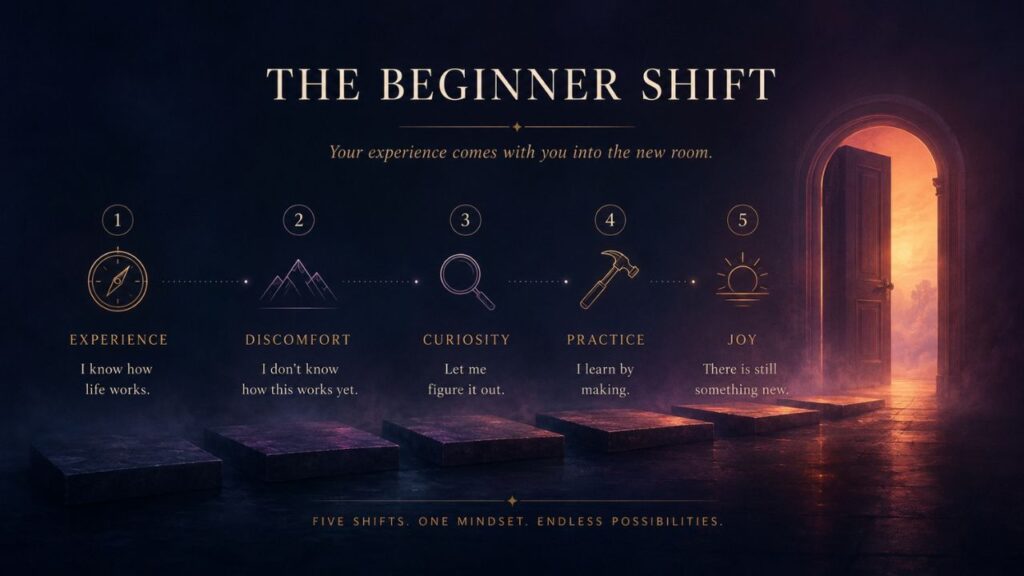
At first, being a beginner can feel uncomfortable because you are constantly reminded of what you do not know. But once that discomfort becomes familiar, curiosity begins to take over.
How does this work?
What happens if I try this?
Could I do that myself?
Is there another way?
That feeling is surprisingly energizing.
After decades of knowing how many familiar things work, there is pleasure in entering a space where there are still doors you have not opened.
The creative result matters, but so does the discovery.
I have learned more because I was willing to become inexperienced again.
And perhaps even more importantly, I have found more joy in the process than I expected.

But curiosity has a dangerous side
There is a complication.
I love figuring out how things work.
That can be a strength, but it can also become one of my biggest distractions.
A simple question can turn into hours of research. One technique introduces another technique. One tool leads to another piece of software. One tutorial produces an idea for an entirely different project.
Before long, the original task has disappeared behind a cloud of interesting possibilities.
This connects directly to the first article in The Second Creative Life, about having too many ideas and not enough focus.
Learning can become another form of avoidance.
It feels productive because you are genuinely gaining knowledge. The problem is that knowledge and progress are not always the same thing.
You can spend three weeks learning everything about how something might be done and still have nothing finished.
For someone like me, the question is therefore not only, “What do I need to learn?”
It is also:
How much do I actually need to learn to complete the work in front of me?
That question puts a boundary around curiosity.
The learning rabbit hole
The internet made independent learning incredibly powerful.
It also created the perfect environment for disappearing into research.
You search for one answer on YouTube and find twenty videos. Each is twelve, twenty, or forty minutes long. One expert recommends one workflow. Another says that approach is completely wrong. A third introduces a tool you had never heard of.
An hour disappears.
Then another.
By the end of the evening, you may know far more than when you started, but the track, photograph, chapter, or project itself has barely moved.
For a multi-passionate creator, there is another danger. Learning something new can generate new projects faster than you can complete the old ones.
You discover a new visual technique and suddenly imagine an Instagram project around it. You learn something about sound design and start thinking about a new music series. You explore a writing tool and another book idea appears.
Curiosity keeps opening doors.
Focus asks you to decide which one to walk through.
AI has changed the learning curve
This is one of the areas where AI has made a real difference for me.
Not because AI removes the need to learn, but because it can shorten the distance between a question and a usable answer.
In the past, learning a specific technique might have meant buying a workshop, purchasing a course, reading a complete manual, or watching hours of YouTube videos before finding the small piece of information you actually needed.
Now I can often ask a very specific question.
I can explain what I am trying to accomplish, what software I use, what I already understand, and where I am stuck. Instead of consuming several hours of material in the hope that my answer is somewhere inside it, I can begin much closer to the problem itself.
For an independent creator, that is a significant change.
It saves money.
More importantly, it can save time.
But only if I use it correctly.
AI should shorten the detour, not create another one
AI has its own rabbit holes.
One answer creates another question. One possibility creates five alternatives. Suddenly, instead of watching three hours of tutorials, you spend three hours exploring prompts and possibilities.
The technology changed.
The underlying temptation did not.
Curiosity still needs a boundary.
The best use of AI for me is increasingly practical: help me understand the next thing I need in order to continue.
Not everything I could possibly learn.
Not twenty alternative systems.
The next obstacle.
If I am working on music, what do I need to solve in this track?
If I am writing, what is preventing this chapter from moving forward?
If I am photographing, what technical issue needs to be understood before the shoot?
That turns AI from an idea generator into something closer to a private tutor.
And for a creator starting or restarting later in life, that can be enormously useful.
There is no shame in asking basic questions
One of the freedoms of learning privately is that you can ask questions you might hesitate to ask publicly.
Basic questions.
Obvious questions.
Questions that make you think, “Surely everyone else already knows this.”
That thought is another small form of Resistance.
If you believe you should already know something, you become less willing to admit that you do not.
But the fastest route to understanding often begins with a simple sentence:
“I don’t understand this yet.”
There is nothing particularly heroic about pretending otherwise.
The important word is yet.
The beginner has permission to experiment
Being experienced creates expectations.
You develop a way of doing things. You know what usually works. Other people may expect a certain result from you.
Beginners have a strange freedom that experts sometimes lose.
They are allowed to experiment.
They can try something without knowing whether it belongs.
They can combine techniques incorrectly and accidentally discover something interesting.
They can ask questions an expert stopped asking years ago.
That does not mean ignorance is better than expertise. Craft matters. Knowledge matters. Experience matters.
But the beginner’s willingness to explore is valuable too.
Perhaps one of the advantages of a second creative life is that you can bring both into the room.
The experience of the older person.
The curiosity of the beginner.
That combination interests me much more than simply becoming an expert again.
You do not need to master everything
There is another lesson I am slowly learning.
Independence does not require complete mastery.
If you create music yourself, you do not need to become the world’s greatest composer, producer, mixing engineer, mastering engineer, graphic designer, marketer, video editor, and social media strategist before releasing one track.
If you publish a book independently, you do not need to become an expert in every part of publishing before anyone can read your work.
You need enough knowledge to make the next good decision.
Then another.
The internet encourages mastery because there is always another tutorial available.
Creative work often needs something simpler.
Competence sufficient to continue.
The deeper knowledge can come with repetition.
The work teaches things tutorials cannot
Eventually, you reach a point where another hour of learning gives you less than an hour of doing.
You cannot learn photography entirely by studying cameras.
You have to take photographs.
You cannot learn music production entirely by watching somebody else move controls on a screen.
You have to make tracks.
You cannot learn how to write books by reading endlessly about writing.
At some point, a manuscript must become your teacher.
Real projects reveal questions you would never have thought to ask in advance.
That is one reason I no longer see being a beginner purely as something to escape.
The beginner is working inside the part of the process where discovery is still happening quickly.
And that can be a wonderful place to be.
When the result finally leaves your hands
Of course, none of this completely removes the uncomfortable moment when the work becomes public.
The photograph goes to the client.
The track reaches the listener.
The book reaches the reader.
You no longer control what happens next.
That moment can make all the uncertainty return.
Was it good enough?
Did I miss something?
Will they notice?
But perhaps the answer is not to wait until that feeling disappears.
Perhaps the answer is to become more familiar with releasing work while the feeling still exists.
Every finished project gives you evidence.
Some things work.
Some do not.
A client likes the photographs.
A listener returns.
A book gets a reader.
A track reaches thousands of streams.
Or perhaps very little happens this time.
All of it teaches you something that private preparation cannot.
The work becomes real.
Being a beginner again may be part of staying alive creatively
There is a version of getting older in which the world gradually becomes smaller.
You know what you like.
You know what you are good at.
You know how you prefer things to be done.
Nothing is especially surprising anymore.
Creativity offers another possibility.
You can deliberately enter rooms where you do not yet know where everything is.
That creates discomfort, but it also creates movement.
For me, becoming a beginner again has not made life feel smaller.
It has made the creative world larger.
I know more now because I allowed myself to know less for a while.
And strangely enough, I think I enjoy the work more because of it.
A different definition of the beginner
Perhaps we need a better definition of what being a beginner after 50 actually means.
It does not mean you have failed to become an expert.
It does not mean your previous experience no longer counts.
It does not mean you are pretending to be something you are not.
It means you have found another area of life large enough to contain things you still do not know.
There is something hopeful in that.
After decades of accumulating answers, you still have questions worth following.
You still have tools worth learning.
You still have things you want to make.
From expert to beginner and back again
I suspect the process never really ends.
You learn enough to become comfortable.
Then you discover another layer.
The comfortable ground disappears again.
Perhaps that is the rhythm.
Not beginner, then expert, then finished.
But beginner, learner, capable, curious, beginner again.
Once I stop seeing that cycle as evidence that I am behind, it begins to feel very different.
The goal is no longer to escape being a beginner as quickly as possible.
The goal is to use that period well.
Learn what the work needs.
Ask the questions.
Accept the discomfort.
Protect your focus.
Then make something with what you have learned.
You do not need to hide the beginner forever.
You only need to keep walking far enough for the beginner to become part of the person who knows a little more than yesterday.
And perhaps that is one of the quiet gifts of a second creative life.
You discover that after 50, there are still things you can do for the first time.
And sometimes, that is where the joy returns.
Continue The Second Creative Life
This article belongs to The Second Creative Life, my ongoing exploration of creativity, Resistance, focus, and meaningful work after 50.
If you are new to the series, begin with The Second Creative Life hub page. If too many interests are pulling you in different directions, read Too Many Ideas, Not Enough Focus. And if the thought “I should have started years ago” keeps returning, continue with The “Too Late” Lie: How Creative Resistance Uses Your Age Against You.
FAQ
Why does becoming a beginner after 50 feel uncomfortable?
By later adulthood, most people have spent decades building competence and becoming accustomed to knowing how to handle familiar situations. Starting a new creative practice removes some of that certainty, which can make ordinary learning feel more emotionally exposed.
Is it harder to learn creative skills after 50?
Learning later in life may feel different, but modern digital tools can reduce many practical barriers. More important is creating enough focused time to practice rather than spending all available time researching how the work should be done.
How can AI help creators over 50 learn new skills?
AI can act as an on-demand learning aid for specific questions about tools, workflows, concepts, and creative problems. It can reduce the need to search through long courses or videos for a single answer, although creators still need to verify important information and apply what they learn through actual practice.
How do I stop learning from becoming procrastination?
Define the problem you need to solve before beginning research. Learn enough to move the current project forward, then return to the work. If research starts producing unrelated ideas and new projects, capture those ideas somewhere and keep the current project active.
Do I need to master every skill if I want to create independently?
No. Independent creators often need working competence across several areas rather than complete mastery of every one. Deeper expertise can develop through repeated projects while outside specialists can still be used where their skill adds meaningful value.
Can being a beginner actually improve creativity?
Yes. Beginners are often more willing to experiment, ask fundamental questions, and explore unfamiliar approaches. When that curiosity is combined with decades of life experience, it can create a particularly useful balance between openness and perspective.