


Sometimes a photograph makes you wonder what a place sounds like.

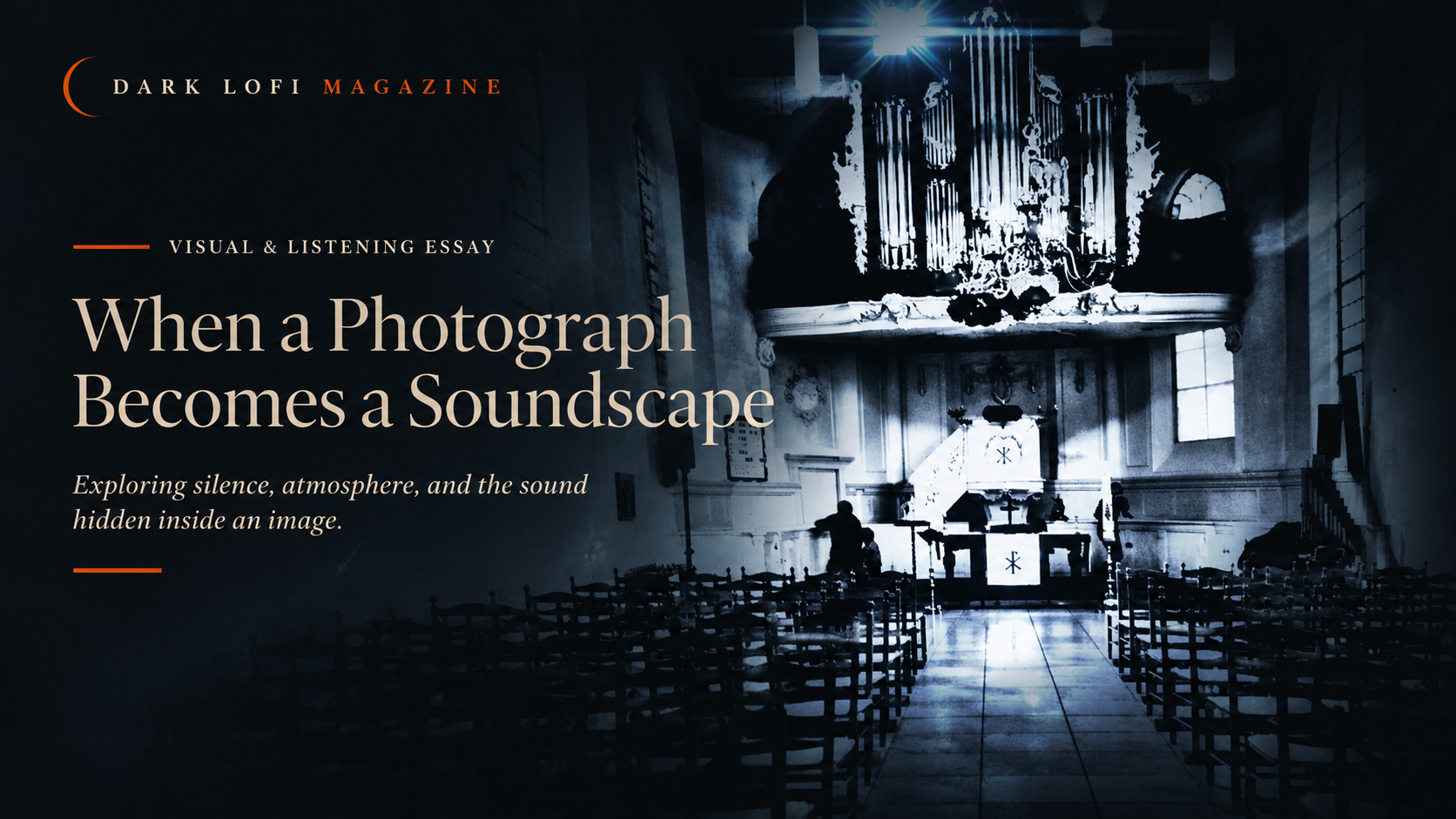
There is something about this photograph that keeps drawing me back.
A church interior. Rows of chairs. A narrow path leading toward the altar. Light pouring into a space that otherwise seems determined to remain in darkness.
A few figures are visible near the front.
The photograph is almost monochrome. Black, white and traces of cold blue. Some details disappear completely into shadow. Others are nearly lost in the brightness.
It is not a technically perfect image.
But perhaps that is why it interests me.
When I look at it, I don’t just see a place.
I begin to imagine its sound.
A Room Made of Light and Silence
Photography captures light. But sometimes it also suggests everything we cannot see or hear.
Look at the chairs.
They create a rhythm across the photograph. Repeating shapes that become less distinct as they approach the altar.
The central aisle gives your eyes somewhere to travel.
At the far end, the light becomes almost overwhelming.
And around it, darkness.
There is a particular tension between these elements. The photograph contains a great deal of visual information, yet much of it remains hidden.
In music, I would describe this as a relationship between sound and silence.
What you leave out can be just as important as what you include.
This relationship also appears in the architecture of silence, where pauses and negative space become essential parts of dark ambient music.
What Would This Photograph Sound Like?
If I translated this photograph into a piece of ambient music, I would not begin with a melody.
I would begin with the room.
A low, sustained tone. Barely noticeable at first.
Something distant, perhaps a soft metallic resonance or a single organ-like note.
I would let it hang in the air.
Then another sound might appear.
A faint movement. A texture that slowly changes. A reverberation that continues long after the original sound has disappeared.
There would be no need for a conventional rhythm.
The repeating chairs already give the photograph its own visual rhythm.
Instead, I would work with distance.
There are even ways to recreate the acoustic character of real buildings. Convolution reverb uses recordings of acoustic responses to simulate how sound behaves in physical spaces.
Some sounds would feel close. Others would seem to come from somewhere beyond the visible space.
And between them, there would be room to listen.
This is one of the things I enjoy about dark ambient music.
It does not always tell you what to feel.
Sometimes it simply creates a place where your thoughts can wander.
The room itself can become part of the experience, something I explored in how listening spaces change ambient music
The Imperfections Matter
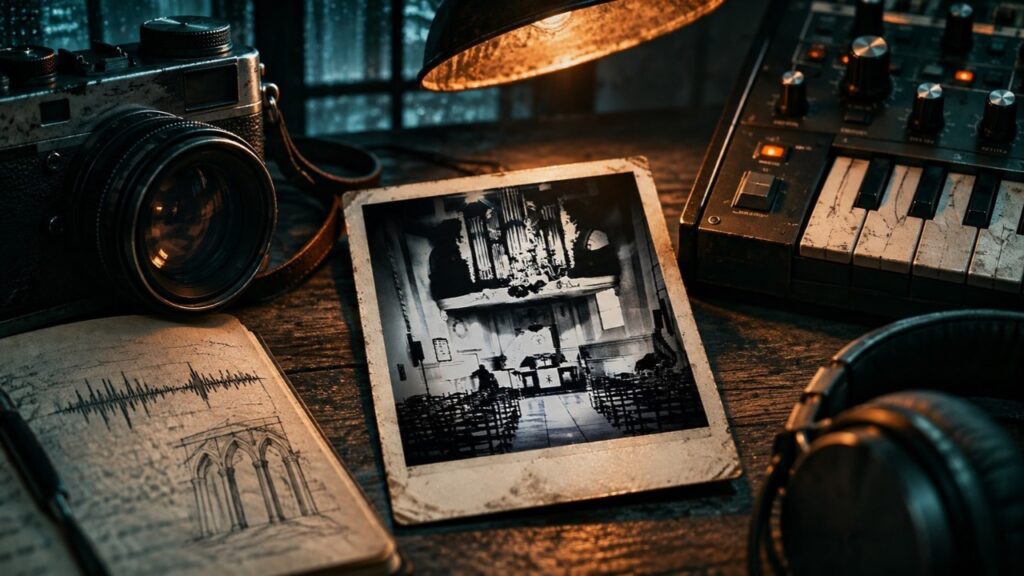
One of the most interesting parts of this image is the way the light almost destroys certain details.
The highlights are bright. The shadows are heavy. The grain is clearly visible.
A more technically balanced photograph might reveal more of the church.
But it might also lose some of this atmosphere.
I think the same can happen with music.
A recording does not always become more interesting when every unwanted noise disappears.
A little texture can give a sound character.
A slight distortion can create distance.
A long reverb can make a simple note feel as though it belongs to a much larger space.
Of course, not every imperfection improves a photograph or a composition.
But sometimes the things we would normally try to correct become the elements that make the work recognizable.
High contrast can change how we experience an image. Adobe’s guide to high-contrast photography explores how deep shadows and bright highlights influence composition and emotion.
Two Ways of Experiencing a Place
Photography and music use different materials.
One works with light, shape and composition.
The other works with sound, time and silence.
Yet they can lead us toward similar experiences.
A photograph allows you to study a single moment.
Music allows you to remain inside an atmosphere as it changes.
Perhaps that is why I find the connection between them so interesting.
When I compose, I often think about spaces rather than songs.
A corridor. An unfamiliar room. An empty station at night.
Places that seem to contain stories, even when nothing is happening.
Photography gives me another way to explore those ideas.
And sometimes, looking at an image is enough to make me want to create a sound.
This connects with the psychology of liminal spaces, where familiar architecture can become emotionally powerful through absence and atmosphere.
What Remains
I don’t know what you hear when you look at this photograph.
Perhaps you imagine footsteps.
A distant voice.
The resonance of a large room.
Or perhaps you hear nothing at all.
That is part of what makes the relationship between photography and music interesting.
We can look at the same image and imagine completely different sounds.
The photograph doesn’t need to explain itself.
Neither does the music.
Sometimes it is enough to create a space and let someone spend a little time there.















Comments 1